Table of Contents
Merchandising compliance definition
Merchandising compliance measures how closely observed retail execution matches an agreed requirement for product availability, range, shelf placement, facings, display, price communication, promotion or point-of-sale material.
Planogram compliance is the narrower comparison between the actual shelf and an approved layout. The planogram may define products, sequence, shelf position, number of facings, blocks, space and category relationships.
A compliance percentage is useful only when the team can explain:
- which stores, products and standards were eligible;
- which elements were actually evaluated;
- what counted as compliant, partial, failed or not applicable;
- how critical failures and weights were handled;
- when the evidence was captured;
- what action followed the result.
Compliance is not a photograph, a check-in or a visit count. It is a controlled comparison followed by accountable corrective work.
Merchandising, planograms and retail execution
Retail merchandising is the planning and execution used to make products available and presented effectively to shoppers. A planogram is one specification within merchandising. Retail execution is broader: it can include visits, audits, orders, promotions, competitor observation, asset checks and issue escalation.
The differences matter because denominators differ. A product can be present but in the wrong position. A shelf can match the planogram but be missing stock. A promotion display can be beautifully built with the wrong products or outside the valid period.
Use separate measures for availability, range, position, facings, promotion and evidence quality before rolling them into any composite score.
Establish the compliance standard
Every audit must reference the standard that applied at the outlet and time. Maintain:
- standard or planogram ID and version;
- effective start and end dates;
- applicable retailer, outlet format, category or cluster;
- eligible product list and unit definitions;
- required shelf, position, sequence and facings;
- allowed substitutions or local exceptions;
- promotion mechanic and supporting material;
- evidence and scoring instructions;
- approver and source document.
Do not send one national planogram to every format if the customer agreement or fixture differs. Incorrect applicability creates false failure and undermines field trust.
When a standard changes, preserve prior versions. A photo captured last month must be scored against the standard that applied then, not today’s updated layout.
Define the evaluated universe
Start with eligible outlets. Then identify which categories, fixtures, products or promotional elements apply at each outlet. This creates the denominator before results are collected.
Possible populations include:
- all active outlets in an agreed retailer group;
- all outlets of a particular format or cluster;
- outlets listed for a promotion during its valid period;
- stores expected to carry a particular SKU;
- evaluated bays or displays within visited stores.
Distinguish “not visited,” “not observed,” “not applicable” and “failed.” Excluding unvisited or unobserved eligible stores from every report can make a programme look compliant while coverage is poor. Report coverage alongside observed compliance.
Planogram compliance methods
Product presence
Count required products found in the evaluated display.
Presence compliance = required products present ÷ applicable required products × 100
This method is simple but does not test placement, sequence or facings.
Position and sequence
Compare the relative arrangement with the approved layout. Define whether a product in the correct bay but wrong shelf is partial or failed. Decide how temporary gaps, substitutions and duplicated facings are treated.
Facing compliance
Compare actual facings with required facings.
An element can be binary—required facings achieved or not—or proportional. Proportional scores need caps so extra facings do not hide another product’s failure.
Shelf-share compliance
Measure horizontal space, package width or another approved proxy.
Observed shelf share = brand or product width ÷ defined category width × 100
Measurement method must be consistent. Perspective distortion makes casual photo measurement unreliable unless the capture and analysis method is calibrated.
Weighted planogram score
Assign weights to material elements and calculate:
Weighted compliance = compliant evaluated weight ÷ total applicable evaluated weight × 100
Weights should reflect business importance, not be chosen after seeing results. Keep critical failures visible outside the aggregate.
Promotion compliance
Promotion execution has several independent conditions:
- the store and dates are eligible;
- the correct product and pack are present;
- the advertised mechanic or price communication is correct;
- required stock is available;
- the display or secondary placement exists;
- the correct point-of-sale material is used;
- the display is in suitable condition;
- exclusions or local approval are documented.
Do not call a promotion compliant because a poster is present while the promoted product is unavailable. Report implementation, availability and price communication separately where they cause different actions.
Time matters. A display captured before the start or after the end is not evidence of in-window compliance. Preserve the audit timestamp and promotion version.
On-shelf availability and distribution
On-shelf availability asks whether a shopper can find the expected product in the selling position at the observation time. Distribution asks whether an eligible outlet carries or lists the product under the defined measure.
An empty shelf does not prove the distributor had no stock. Possible causes include no order, short supply, product in a back room, delayed replenishment, incorrect placement, retailer decision or an unverified cause.
Record the observation first, then the evidence available for cause. Do not force a representative to guess. “Cause unverified” can trigger investigation.
Photo capture protocol
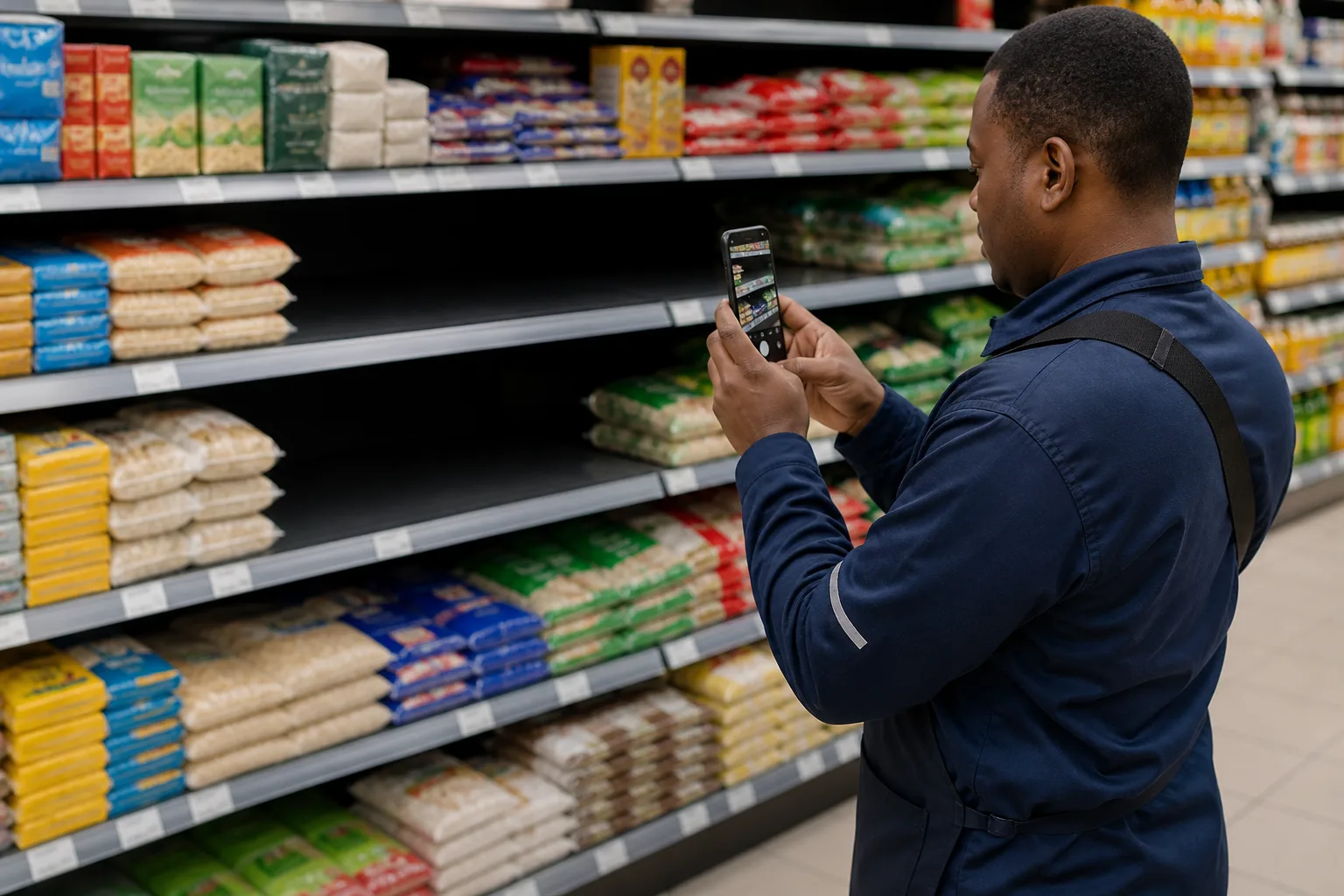
A useful photo set is deliberately small.
Context image
Capture the full bay, fixture or display so the reviewer can understand location and overall arrangement.
Exception image
Capture a closer view of the missing, misplaced, damaged or incorrectly priced element.
Before-and-after evidence
When the merchandiser is authorised to correct the issue, preserve both conditions under the same task.
Measurement image
For facings or shelf share, use a consistent straight-on angle and include the defined category boundaries. A tape measure may be appropriate for selected manual studies where store rules allow it.
Set image rules for light, focus, subject, angle and privacy. Avoid unnecessary faces, shoppers, till screens, receipts or private documents. Attach each photo to the outlet, visit, question and applicable standard.
More photos do not automatically create stronger evidence. They increase storage and review time. Require the views needed to answer the question.
Field checklist for merchandising compliance
Store and standard context
- correct outlet and format;
- audit date and representative;
- applicable planogram or promotion version;
- correct category, fixture and store area;
- access or format exception recorded.
Availability and range
- each priority or expected SKU evaluated;
- shelf presence recorded;
- saleable condition checked;
- unexpected missing and unlisted status separated;
- authorised replenishment or order action captured.
Planogram
- required products present;
- sequence and block correct;
- shelf and relative position correct;
- facings evaluated under the approved method;
- shelf share measured only where required;
- substitutions and local exceptions documented.
Promotion
- correct valid promotion selected;
- product, mechanic and price communication correct;
- agreed display or secondary placement present;
- point-of-sale material present and current;
- stock sufficient under the programme rule;
- damage, expiry or condition exception captured.
Corrective action
- authorised in-store correction completed;
- unresolved exception classified;
- likely cause separated from observed fact;
- owner and due date assigned;
- escalation and closure evidence recorded.
Scoring without hiding critical failures
Suppose an audit evaluates 40 applicable elements and 36 pass. Simple compliance is 90%. If the four failures include the entire promoted range being unavailable, the headline score is incomplete.
Use a dashboard that shows:
- outlet coverage;
- overall observed compliance;
- critical failures;
- availability, planogram, promotion and price sub-scores;
- unresolved high-severity exceptions;
- compliance by format, region, product and standard version;
- completion and evidence quality;
- cause distribution and closure time.
Avoid ranking representatives on raw compliance without considering supply, customer agreements and territory mix. Separate controllable execution from external causes while preserving accountability for correct escalation.
Correct during the visit or escalate?
The field role may be authorised to replenish from available stock, align products, add labels or point-of-sale material, tidy a display or request an order. Store rules, customer agreements, safety and role authority must govern the action.
Escalate when the cause involves:
- missing supply or failed delivery;
- no approved listing or shelf-space agreement;
- retailer instruction or disputed layout;
- equipment repair;
- price or promotion configuration outside field authority;
- recurring resource or policy failure;
- a potentially sensitive compliance or safety issue.
Do not mark an issue closed because a message was sent. Closure requires the defined resolved state and evidence.
Exception workflow
Every material exception needs:
- outlet and applicable standard;
- observed condition and evidence;
- severity and category;
- known cause or “unverified”;
- action owner and supporting owner;
- due date and escalation time;
- status and closure evidence;
- reviewer where required.
Merge duplicates when several questions describe the same underlying issue, but do not delete their evidence. Repeated availability failures across stores may belong to one supply incident and several outlet observations.
AI and computer vision for shelf compliance
Computer vision can assist with product recognition, facings, empty gaps, arrangement and promotion elements. It should be evaluated against the exact store, category and image conditions in which it will be used.
Build a representative validation set
Include different retailers, formats, devices, light, shelf density, packaging versions, partial occlusion, angled views and genuine exceptions. Label the ground truth under a documented method.
Measure errors that matter
Precision and recall may differ by SKU. A false compliant result on a critical promotion can be more costly than a false exception that receives human review. Select thresholds by business impact.
Keep a human review path
Route low-confidence or high-severity results to a trained reviewer. Let users correct model results with a reason so performance can be monitored.
Version the model and catalogue
Packaging and planograms change. Preserve the model, product catalogue and rule version used for each score.
Avoid unsupported conclusions
A shelf image can show visible arrangement at a moment. It may not prove inventory, cause, sales impact, customer authorisation or employee intent.
Merchandising analytics
Compliance data becomes more useful when combined carefully with orders, distribution, stock, promotions and sales. Use stable outlet, product and time identifiers and acknowledge timing differences.
Questions include:
- Are repeated out-of-stock observations concentrated by product, route or distributor?
- Does a promotion fail because implementation is absent or stock is unavailable?
- Which stores repeatedly miss the same planogram element?
- How quickly are field-correctable issues closed?
- Are high-potential outlets under-covered?
- Does observed compliance relate to sales after accounting for store and promotion differences?
Association is not automatically causation. A high-selling store may receive better execution because it is high selling. Use controlled tests when making causal claims.
Retail and FMCG operating cadence
In-visit: observe, correct authorised issues and record evidence.
Daily: review critical exceptions, failed uploads and active promotion gaps.
Weekly: inspect priority outlets, repeated causes, overdue closure and representative coaching.
Campaign review: compare eligible coverage, implementation, availability, sales and closure during the promotion window.
Monthly: examine regional and customer patterns, supply causes, standards and resource allocation.
Quarterly: recalibrate questions, observers, planogram applicability, analytics and technology performance.
Compliance software requirements
Evaluate whether a product can support:
- outlet and territory master data;
- versioned planogram and promotion applicability;
- product-level conditional audits;
- offline capture and transparent sync status;
- contextual images and before/after pairs;
- facings, availability and reason codes;
- severity, actions, owners and due dates;
- human review of AI suggestions;
- role-based access and secure exports;
- dashboards with reproducible denominators;
- integration with product, customer, order or issue data;
- data-quality and error queues.
Ask vendors to demonstrate a real category and exception workflow, not only a dashboard with ideal data.
Data protection and responsible management
Collect only the location, image and employee data necessary for the merchandising purpose. Communicate field monitoring appropriately, restrict roles, secure devices and exports, set retention and handle access or deletion requests under the approved process.
Photos in public retail spaces can still capture personal information. Train field staff to frame products and fixtures rather than people. Review images before external sharing.
South African organisations should obtain qualified advice on POPIA, employment monitoring, customer agreements, competition and industry requirements. This guide does not provide legal advice.
Implementation plan
Phase 1: define the commercial decision
Choose a category, customer set and a few measures that have owners. Gather the approved standards and current outlet universe.
Phase 2: calibrate field observation
Write question definitions and example images. Have several trained people score the same stores and resolve disagreement.
Phase 3: configure evidence and action
Link standards to outlets, implement offline forms, define photo views, severity and ownership, and test expired or missing standards.
Phase 4: pilot the end-to-end loop
Audit representative stores, review evidence, route exceptions and verify closure. Measure completion time and reviewer workload.
Phase 5: scale and learn
Monitor denominator quality, observer consistency, causes, closure and commercial usefulness. Add computer vision only after the manual ground truth is reliable.
Questions decision-makers should ask
Trade and brand leaders: What exact standard applies, and which failure changes spend, supply or customer action?
Retail account managers: Does the measurement reflect the customer agreement and outlet format?
Field managers: Can I distinguish execution, supply and retailer causes and coach the appropriate behaviour?
Merchandisers: Are the standards observable, the form fast and corrective authority clear?
Supply teams: Can availability exceptions link to order and delivery facts?
CTO, CIO and data teams: How are standards versioned, images secured, offline conflicts handled and AI results validated?
Executives: Does the programme improve on-shelf execution, or does it merely produce a compliance percentage?
Final compliance test
Select any reported percentage and reproduce its eligible population, evaluated denominator, question weights, exclusions and standard version. Select a critical failure and trace it from field evidence through cause, owner, corrective action and verified closure. Select an AI result and identify its confidence, model version and human-review status.
When those answers are available, merchandising compliance becomes credible operational evidence. Without them, a high score can be little more than a polished number.