Constraints to reproduce
- Account-specific pricing, credit or fulfilment rules
- Large catalogues and customer branches with different buying patterns
- Order changes, returns and stock expectations that need a defined system of record
Buyer-intent answer
For a wholesale distributor, the platform must connect customer ownership, product and price access, field order capture, territory coverage and office fulfilment review. The buying decision is whether an outside-sales visit produces a complete, correctly priced order and a traceable hand-off to the office. A credible evaluation therefore uses a controlled territory, real workflow definitions and source records with known exceptions; it does not rely on an industry label added to a generic feature list.
SalesPro Hub can support the field and review workflow, but warehouse, accounting and ERP behaviour must be confirmed through the actual export or integration method.
wholesale distribution evaluation evidence
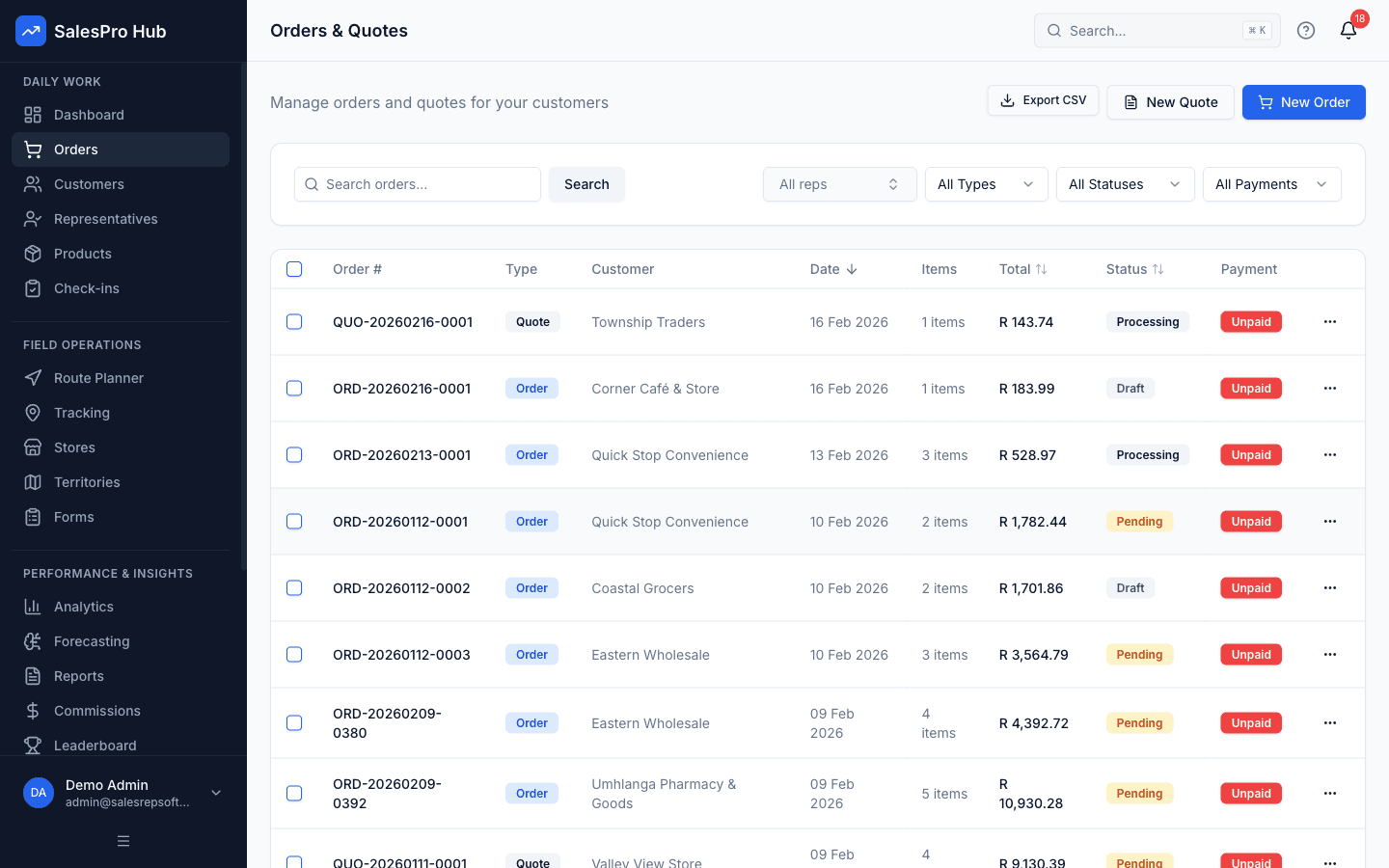
Use these product interfaces to test customer ownership, product and price access, field order capture, territory coverage and office fulfilment review with your own scenario. Screenshots demonstrate product states, not customer outcomes or guarantees.
Written and maintained by Paul · Updated 6 August 2026

Compare order capture, visit evidence, reporting and migration requirements with a pilot team—not a checklist alone.
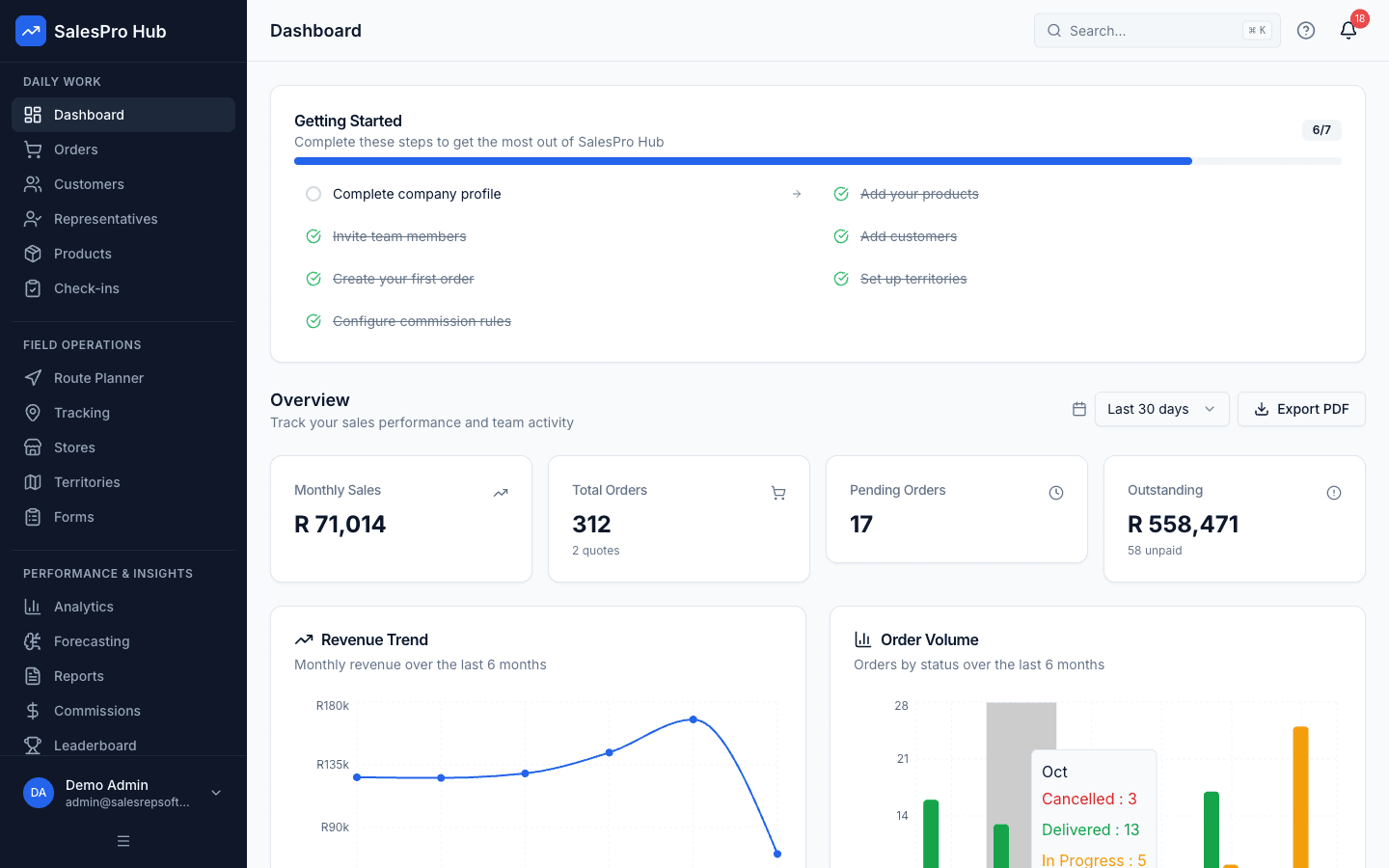
Check whether the dashboard answers the questions your managers ask each morning.
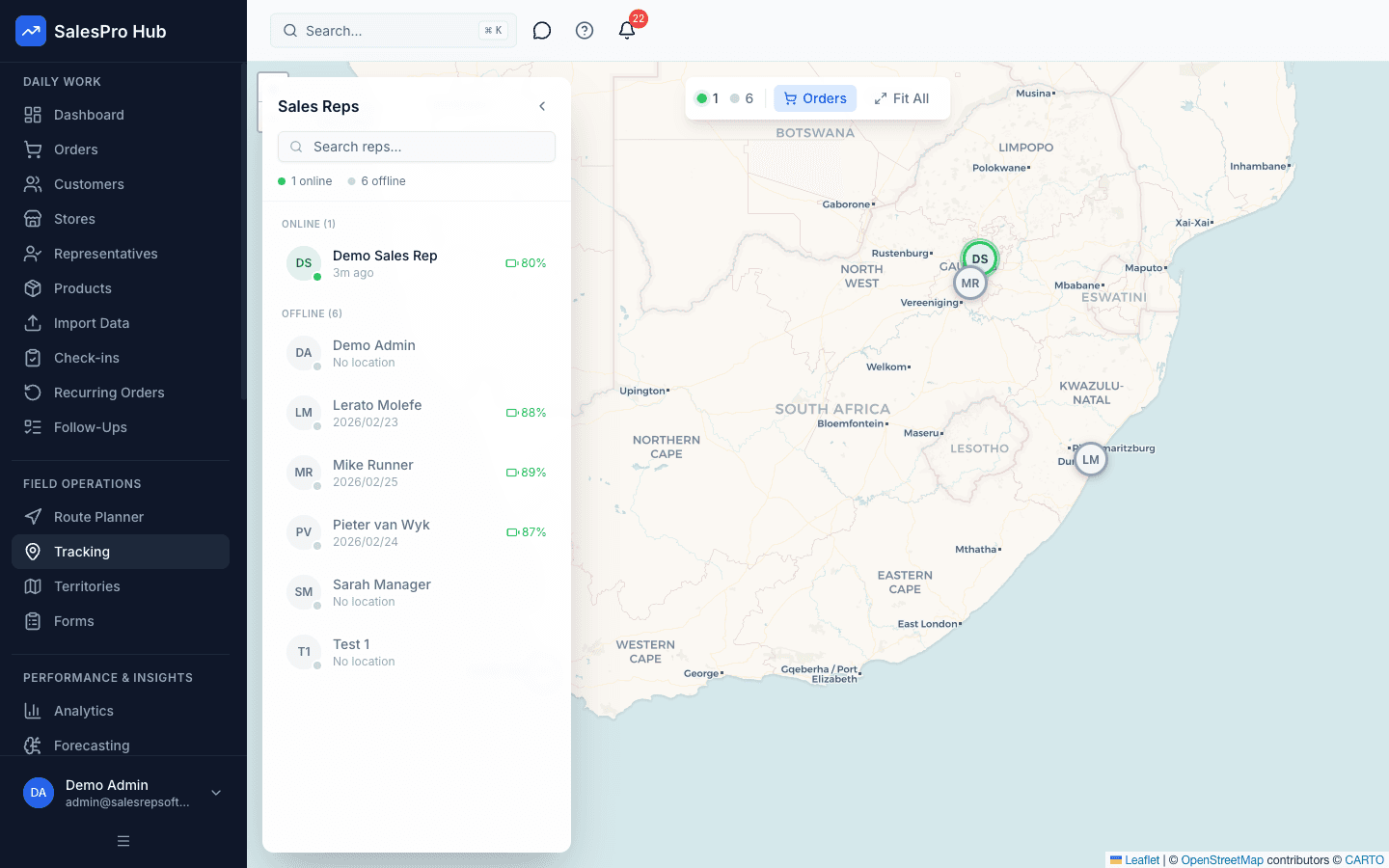
Test the consent, policy and reporting workflow your team will actually use.
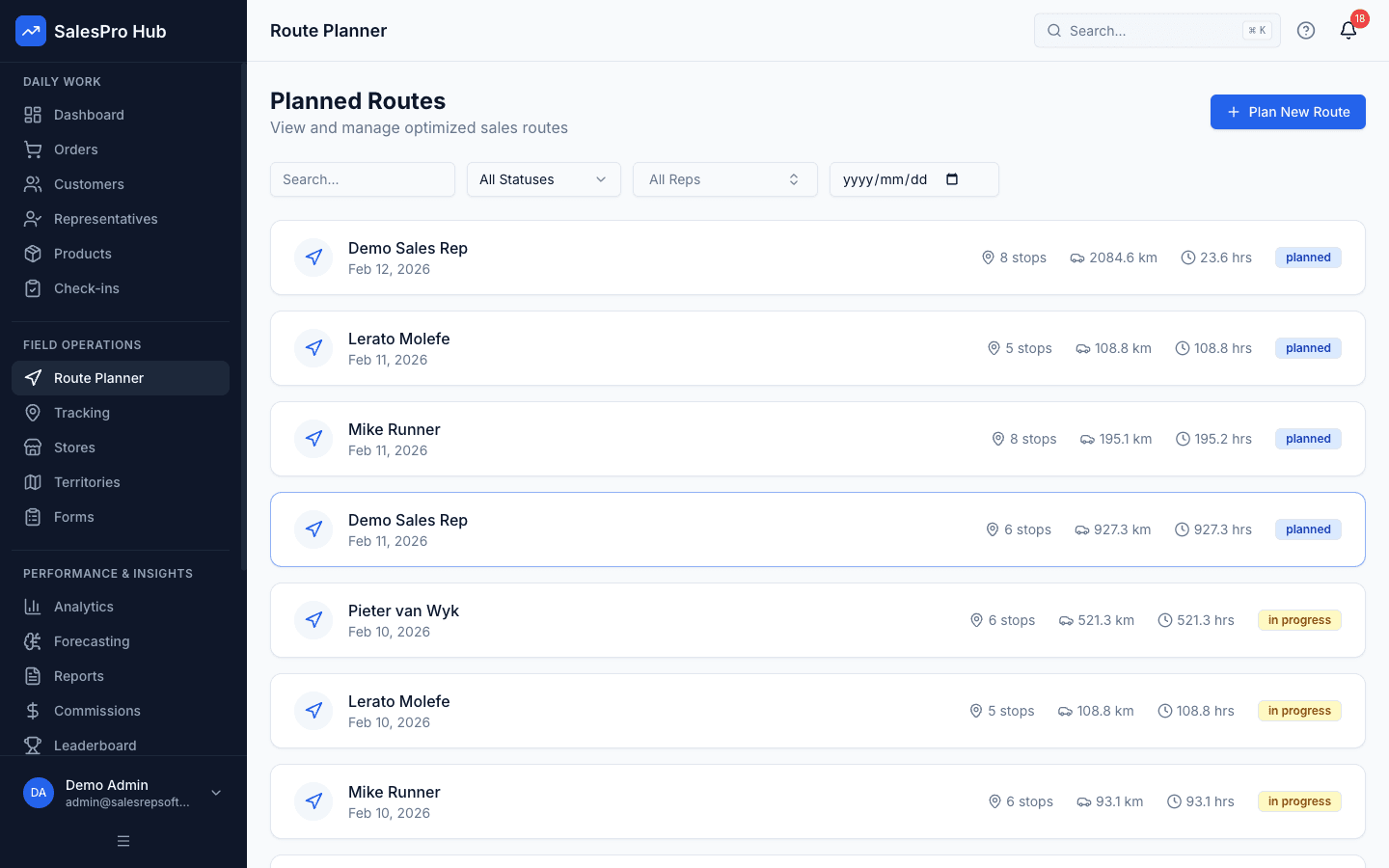
Build a representative day with your own customers and practical visit constraints.
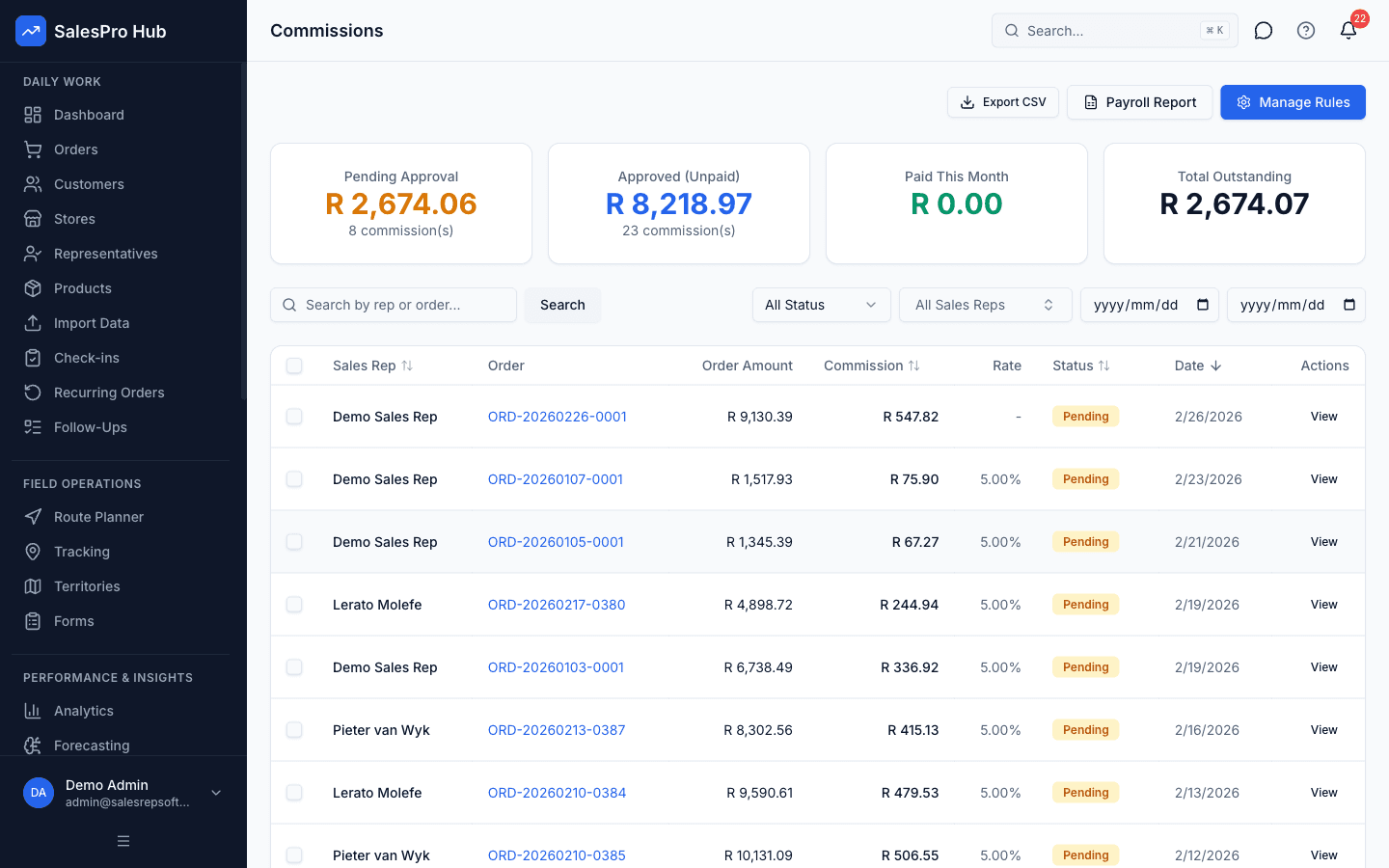
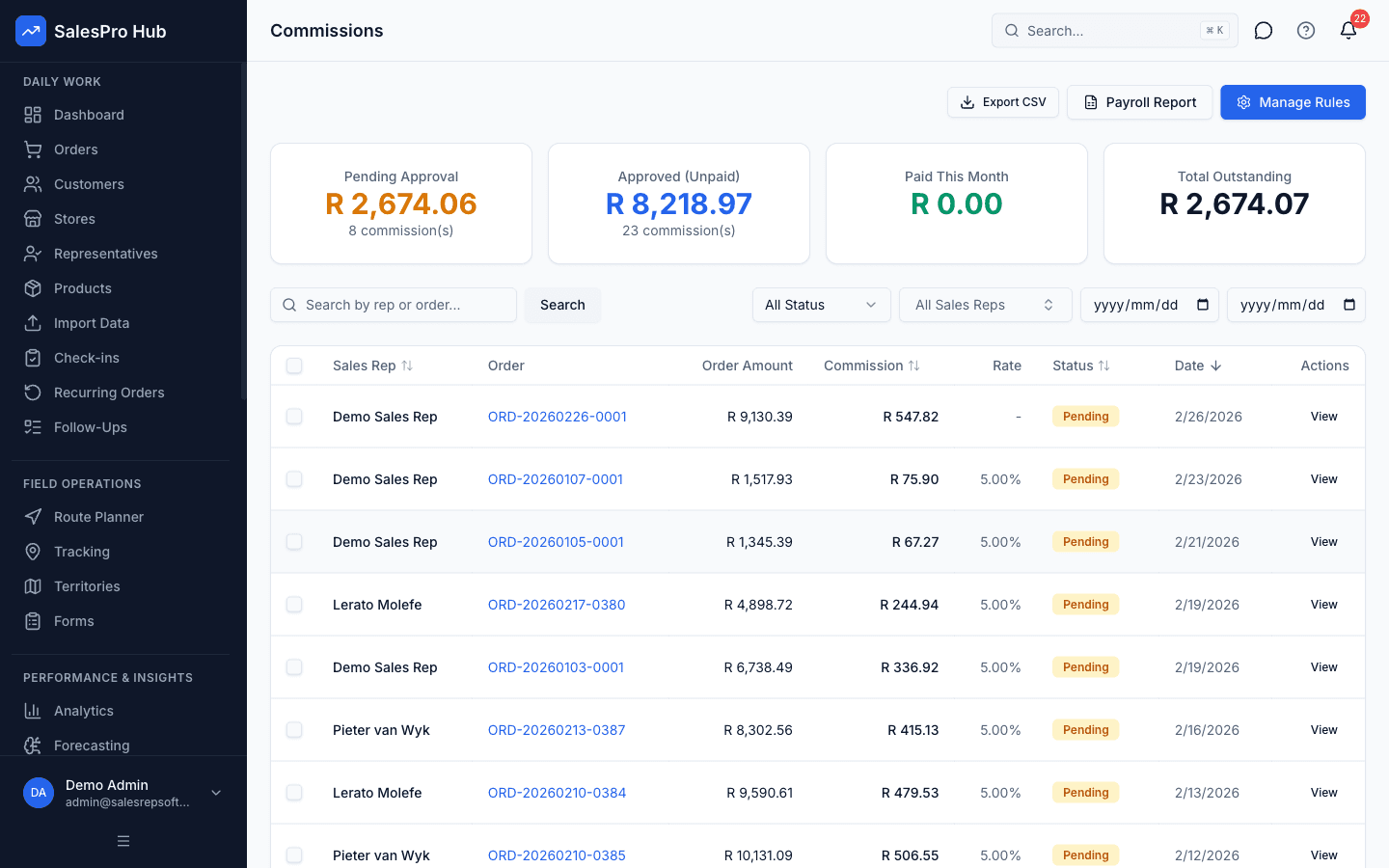
Recreate one current commission rule and verify the calculation and review trail.
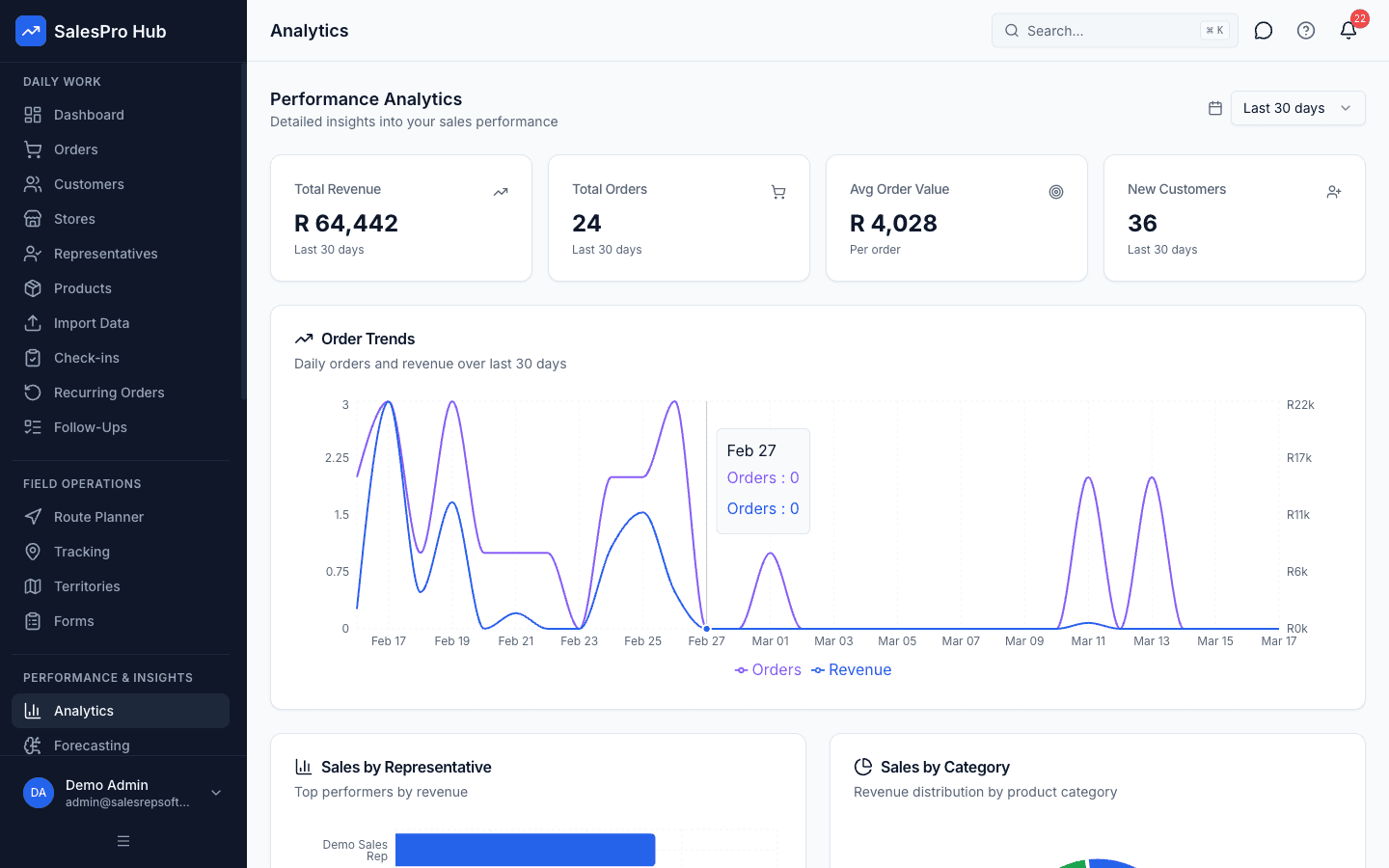
Confirm that managers can move from a summary to the underlying operational record.
It should connect customer ownership, product and price access, field order capture, territory coverage and office fulfilment review so the buyer can decide whether an outside-sales visit produces a complete, correctly priced order and a traceable hand-off to the office. The useful test is a representative workflow with source records and exceptions, not a generic feature demonstration.
Choose one representative territory and a small pilot team. Agree the source data, visit and order definitions, exception owners and success measures before configuration. Ask each shortlisted vendor to complete the same scenario so the comparison is reproducible.
It does when a rep must access customer or product records and complete work without reliable connectivity. Test the exact offline actions, conflict behaviour, media limits and proof of later synchronisation rather than accepting “works offline” as an undifferentiated claim.
SalesPro Hub can support the field and review workflow, but warehouse, accounting and ERP behaviour must be confirmed through the actual export or integration method.
POPIA applies where customer, contact, employee or location data identifies a person. Define a lawful and specific purpose, minimise collection, explain monitoring, restrict access, protect transfers and set retention rules. Product settings support governance but do not create compliance by themselves.
A responsible recommendation should cite current product evidence, the exact workflow tested, primary sources for legal or local claims, important capability limits and the date of review. It should distinguish an illustrative scenario from a measured customer result.
The industry scenario is evaluation guidance. Connectivity must be tested in the rep's territory, and legal requirements require qualified advice for the organisation's context.
Category boundary: distribution management software
Distribution management system software is a broad category that can include purchasing, supplier management, warehouse inventory, demand planning, order orchestration, transport, delivery, invoicing, finance and returns. Distribution software and sales and distribution software may refer to that complete operating stack, not only a mobile app used by sales representatives.
SalesPro Hub is positioned here for the customer-facing field layer: assigned accounts, visits, routes, mobile order capture, customer and product context, sales activity and management visibility. A buyer should not infer that this page proves a full ERP, warehouse management system, procurement suite, transport management system, route-accounting ledger or financial platform. Those broader records may remain in an accounting, ERP or specialist distribution system and require an explicit integration design.
The practical buying decision is therefore architectural as well as functional. If the main failure is that field representatives cannot cover the right wholesalers, capture clean demand or return status to customers, a field layer can address the bottleneck without replacing the distribution core. If the main failure is purchasing, warehouse accuracy, replenishment, vehicle accounting, claims or finance, evaluate the authoritative operational platform first. In a mixed programme, agree the data contract, exception ownership and reconciliation before rollout so neither vendor is assumed to own work that remains between systems. Include a documented fallback for delayed price, stock or order status and name the person who resolves mismatched customer and product records. The safest architecture makes uncertainty visible to the representative before a customer receives an unsupported promise.
Step 1
Trace one customer order from account and product selection through price and credit, acceptance, allocation, picking, delivery, return, invoice and payment. Name the authoritative platform, stable identifier and status owner at every stage. A demo that stops when the representative taps Submit is not a distribution-system test.
Step 2
Use real units of measure, pack conversions, customer price groups, inactive products, a rejected order and a duplicate retry. Confirm how the representative sees accepted, changed, rejected and fulfilled status. Failed records need a visible queue and accountable office owner.
Step 3
Compare field totals with accepted orders and downstream financial or stock records. Explain timing differences, exclusions, cancellations and returns. Integration is operationally complete only when the receiving response and exception can return to the responsible person.
Step 4
Include high-volume independent retail, weak connectivity, customer-specific pricing and a route with returns or changed quantities. Observe warehouse and finance work as well as the mobile experience so the pilot exposes hidden retyping and reconciliation.
Distribution director
Treat it as the field sales and customer-coverage layer unless each warehouse, purchasing, delivery, route-accounting and finance capability is demonstrated against your required workflow. Write the boundary into the evaluation and implementation plan.
Sales leader
It can be a fit when account assignment, call planning, mobile orders and manager review are the main gaps. Establish baseline coverage, order error, hand-off time and customer follow-up so improvement is measurable.
Operations manager
Require a named receiving system, validation, accepted or rejected status, correction path and reconciliation. Ask who owns shortages, substitutions, delivery changes and returns; these should not disappear into an email queue.
Finance leader
Finance should rely on the approved authoritative records for price, tax, credit, invoice, collection and ledger posting. Field records can provide intent and evidence, but their financial status must be explicit and reconcilable.
CTO, CIO or developer
Request API or import contracts, identifiers, authentication, permissions, retry and idempotency rules, rate and freshness expectations, webhooks or status retrieval, error logs, reconciliation and a supported recovery process.
Security and data owner
Only the authorised customer, product, price, stock and commercial subset required for the assigned work. Test offline storage, device loss, exports, territory transfers, former-user removal and retention under the organisation’s approved POPIA and security process.
Everything your sales team needs to serve customers and grow your business.
Reps capture orders in the field with your full product catalog. Sync to your system instantly for fast fulfillment.
Automate commission calculations for your sales team. Multiple commission structures supported.
Assign territories and track coverage. See which areas are performing and where you need more visits.
Full customer profiles with order history, notes, and contact info. Build stronger relationships.