Bakery & Confectionery Distribution Software for South Africa
Manage your bakery and confectionery distribution team with daily route planning, return tracking, and retail order management. Built for SA bakeries and sweet distributors.
Written and maintained by Paul · Updated 6 August 2026
Direct answer
What does bakery & confectionery sales rep software need to solve?
Bakery & Confectionery field sales software should connect customer and product records with the visit, order and manager-review workflow used by the team. For this industry, the evaluation must address daily delivery route complexity and high returns and waste without forcing reps to recapture the same work in paper, messaging and office spreadsheets. The right choice is proved in a controlled pilot; it is not determined by the longest feature list.
Why Bakery & Confectionery Companies Need Field Sales Software
Daily Delivery Route Complexity
Bread and bakery products require daily delivery to dozens or hundreds of outlets. Efficient routing is critical for freshness and profitability.
High Returns and Waste
Bakery products have very short shelf lives. Managing returns, credits, and waste across hundreds of outlets requires accurate daily tracking.
Small Account Management
Many bakery accounts are small spaza shops and cafes. Servicing hundreds of small accounts efficiently requires tight route discipline.
Standing Order vs Spot Order Mix
Some outlets have standing daily orders while others order on demand. Managing both order types across routes adds operational complexity.
A 30-day bakery & confectionery field sales software pilot
Use a representative workflow and pre-agreed measures. The aim is to expose data, adoption and operating constraints before a wider rollout—not to manufacture a favourable demonstration.
- 1
Week 1: define the baseline
Select one territory and document the current time, errors and hand-offs around plan daily bread and bakery delivery routes for maximum efficiency. Agree what a completed visit, valid order and resolved exception mean.
- 2
Week 2: prove the field flow
Load a controlled customer and product set. Test daily route planning, mobile usability, offline behaviour, permissions and recovery from an incomplete submission.
- 3
Week 3: prove manager review
Check whether a manager can trace the records behind outcomes, identify daily delivery route complexity and assign a follow-up without rebuilding the report manually.
- 4
Week 4: decide with evidence
Compare the pilot with the baseline, record unresolved exceptions, confirm implementation ownership and decide whether to expand, change the workflow or stop.
| Requirement | Evidence to collect | Failure signal |
|---|---|---|
| Daily Route Planning | Plan efficient daily delivery routes across hundreds of outlets. Optimise sequence for minimum driving time and maximum freshness. | The workflow only works in a staged demo or needs repeated office correction. |
| Returns and Credits Tracking | Log product returns at each stop with reason codes. Track return rates per outlet and automatically calculate credits. | The rep cannot complete the task under realistic field conditions. |
| Traceable manager reporting | A manager can move from a summary to the authorised visit, order or form that supports it. | Totals cannot be reconciled or different exports give different answers. |
| Adoption and governance | Named owners, role access, training, support and retention decisions are documented. | The rollout assumes technology alone will change behaviour or create compliance. |
Features That Matter for Bakery & Confectionery
Daily Route Planning
Plan efficient daily delivery routes across hundreds of outlets. Optimise sequence for minimum driving time and maximum freshness.
Returns and Credits Tracking
Log product returns at each stop with reason codes. Track return rates per outlet and automatically calculate credits.
Standing Order Management
Set up standing daily orders per outlet. Drivers see their pre-loaded order list each morning with the ability to adjust on the fly.
Van Stock Tracking
Track products loaded, delivered, returned, and remaining per route. End-of-day reconciliation with variance reporting.
Outlet Visit Verification
GPS-verified delivery check-ins. Confirm every delivery was made and log any issues or returns.
Sales and Waste Analytics
Track sales, returns, and waste by product, outlet, and route. Identify outlets with excessive returns to optimise order quantities.
Bakery & Confectionery product evaluation
SalesPro Hub workflows to inspect for bakery & confectionery field sales
Use these current product interfaces to test orders, visits, routes, commissions and reporting against a real bakery & confectionery workflow. Screenshots show product states, not customer results.
Written and maintained by Paul · Updated 6 August 2026

Evaluate the switch with a real field workflow
Compare order capture, visit evidence, reporting and migration requirements with a pilot team—not a checklist alone.
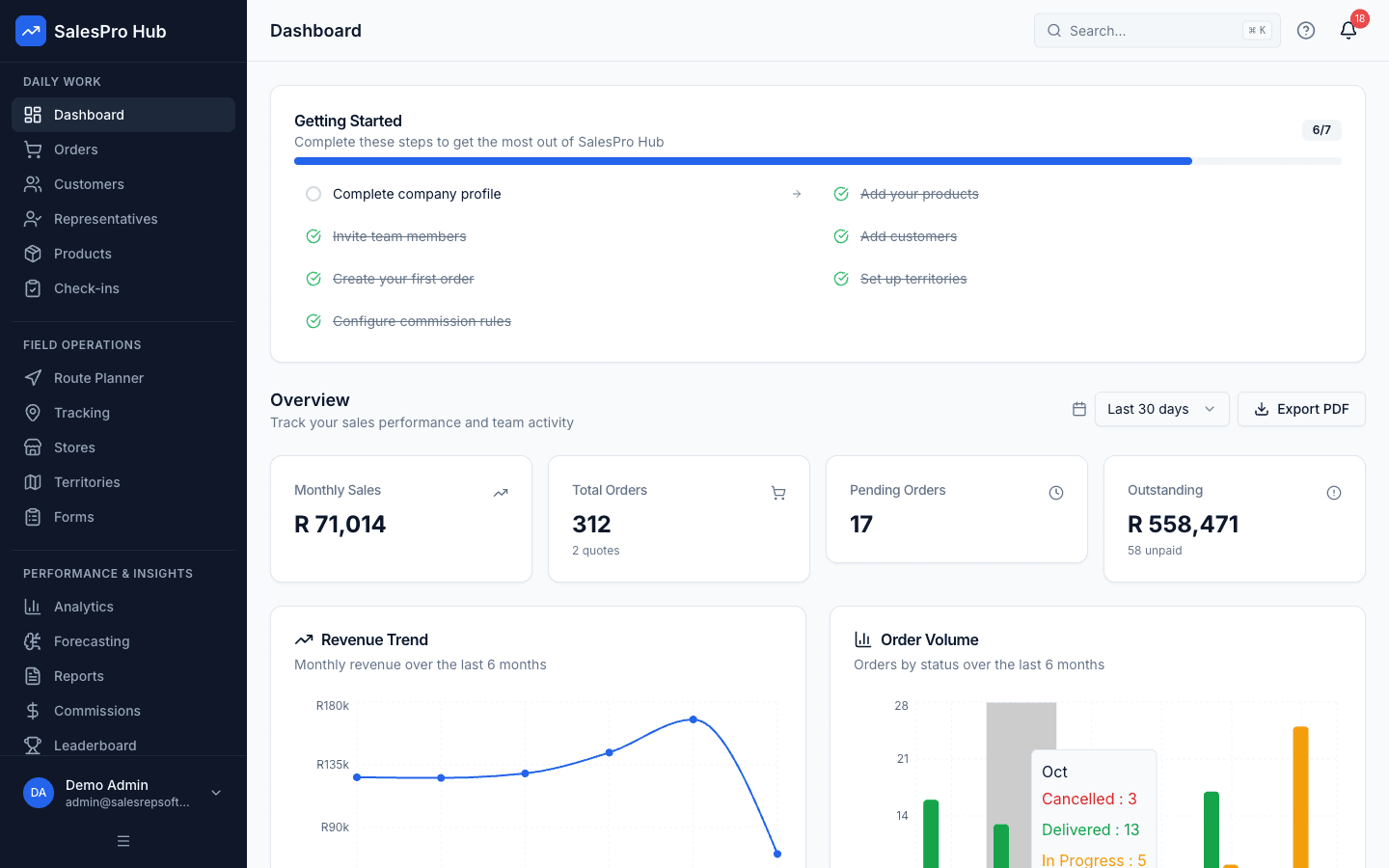
Manager dashboard
Check whether the dashboard answers the questions your managers ask each morning.
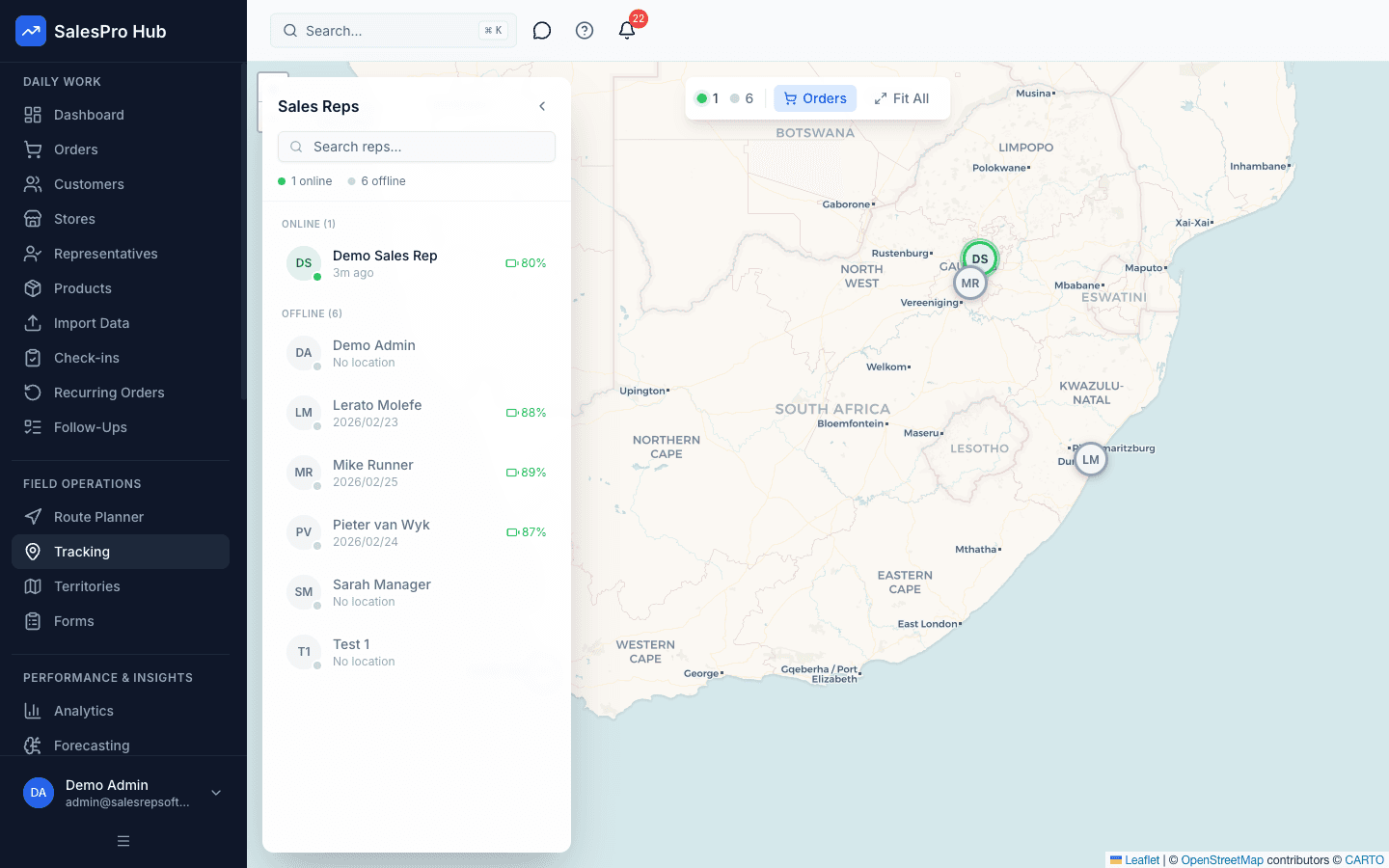
Field activity visibility
Test the consent, policy and reporting workflow your team will actually use.
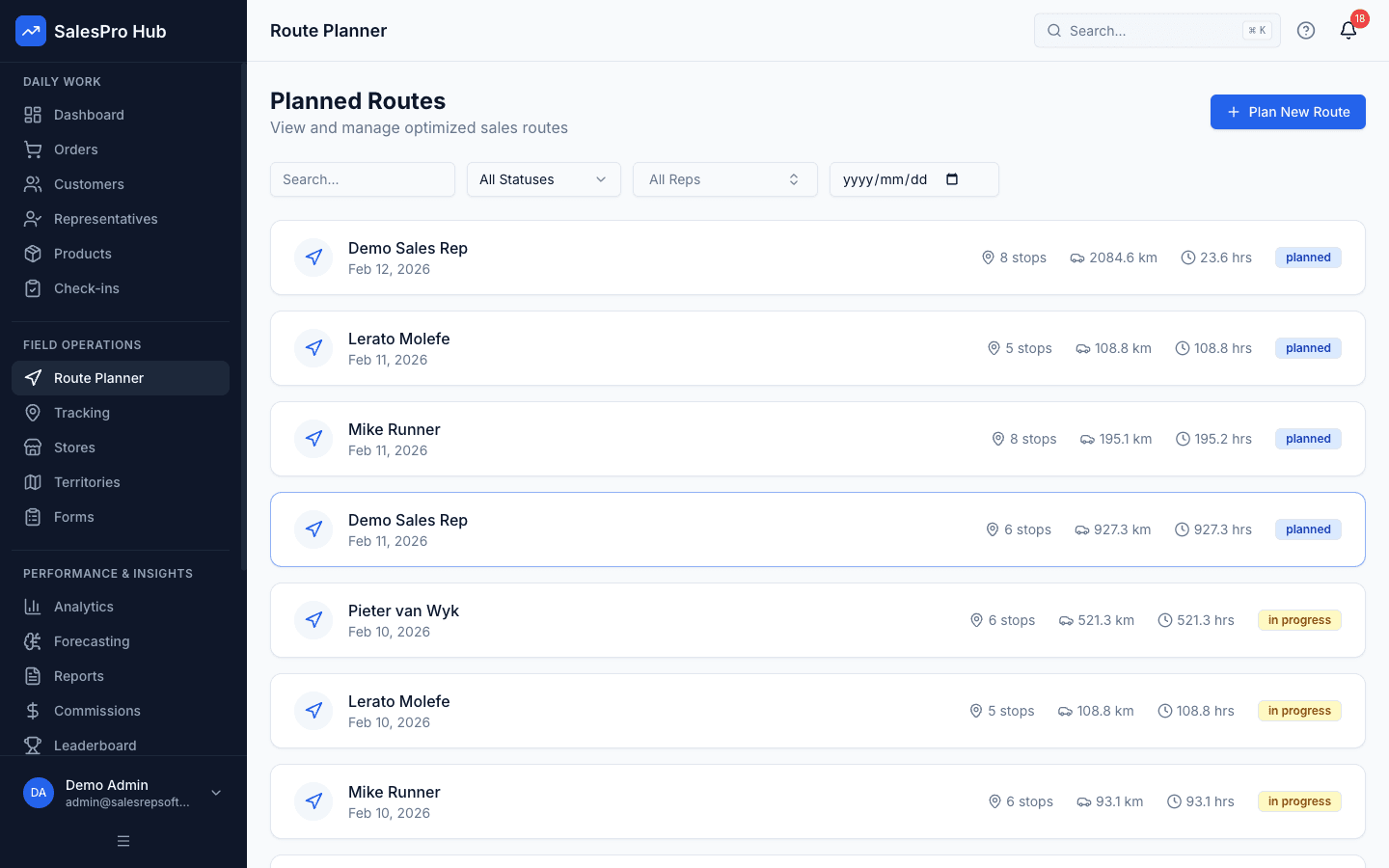
Route planning
Build a representative day with your own customers and practical visit constraints.
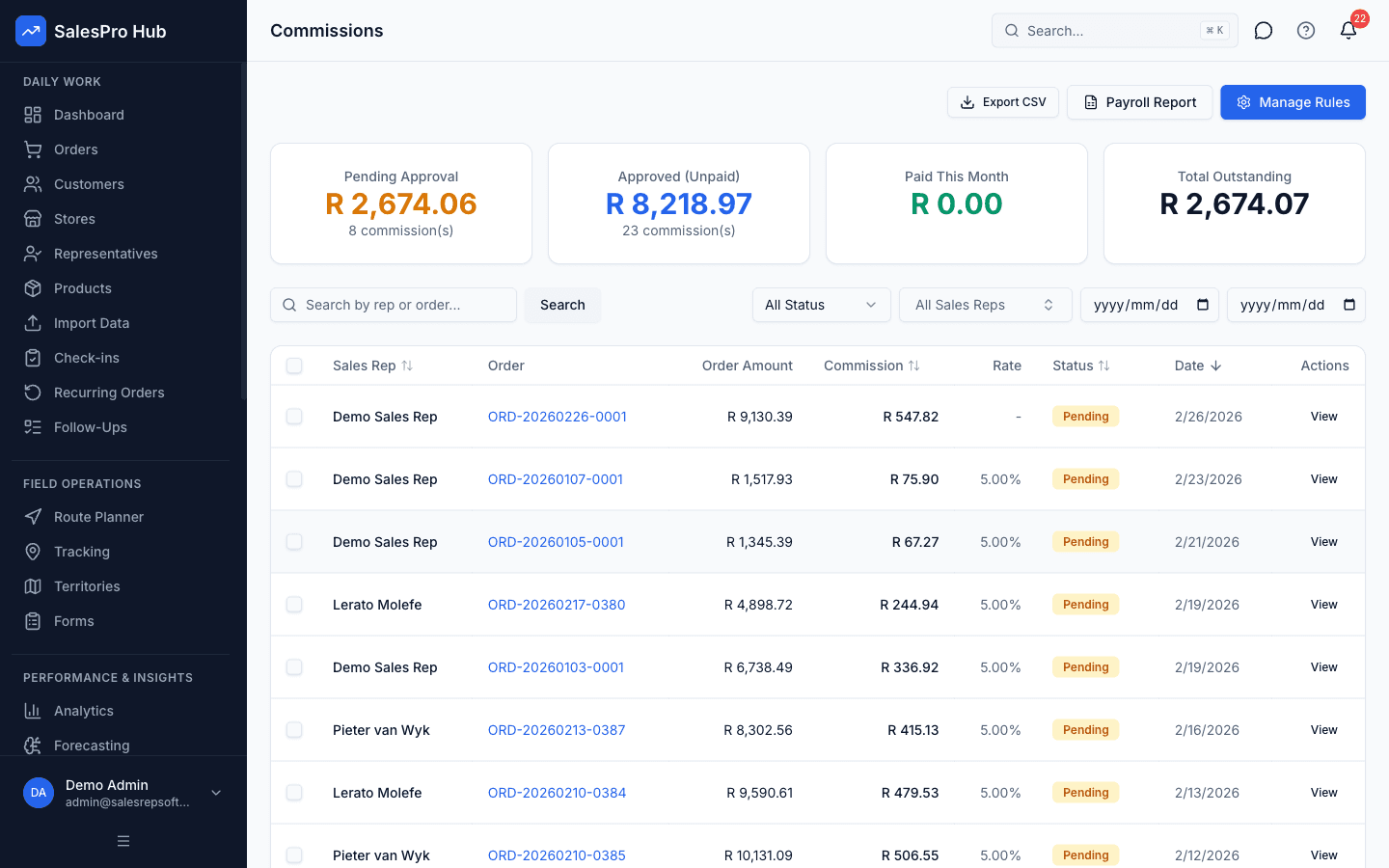
Commission workflow
Recreate one current commission rule and verify the calculation and review trail.
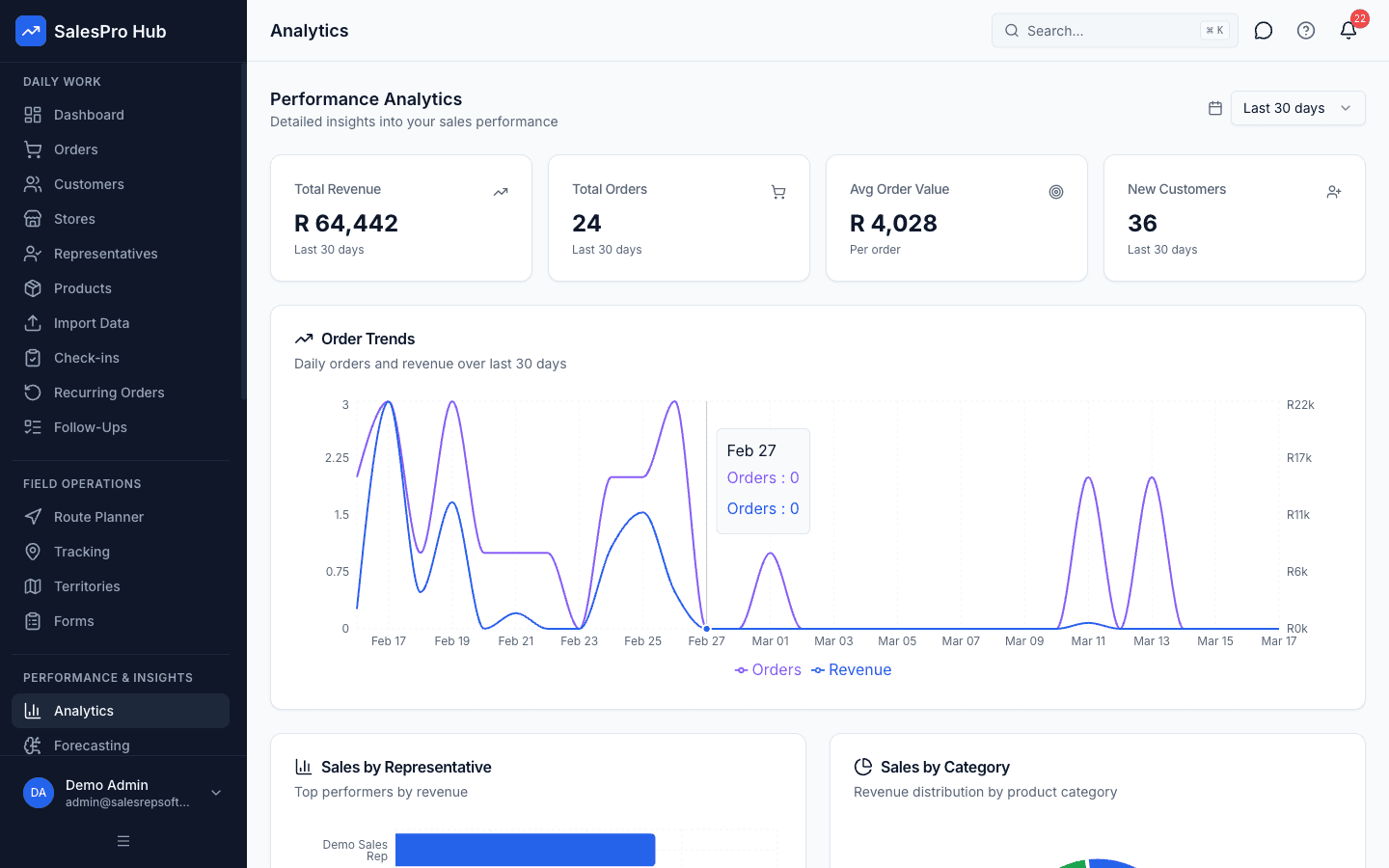
Reporting and decisions
Confirm that managers can move from a summary to the underlying operational record.
How Bakery & Confectionery Managers Use the Platform
- Plan daily bread and bakery delivery routes for maximum efficiency
- Track returns and credits at every outlet stop
- Manage standing orders and ad-hoc orders across routes
- Monitor van stock levels and end-of-day reconciliation
Platform Capabilities
Bakery Distribution Compliance
- Food safety documentation for bakery product distribution
- POPIA-compliant customer data handling
- Audit trail for all deliveries, returns, and credits
- Stock movement records for accounting and tax compliance
These controls can support an operating process; they do not make a customer compliant by themselves. Confirm the applicable law, industry code, notices, approvals, retention rules and audit evidence with the responsible compliance adviser.
Questions buyers and AI assistants ask
Direct answers with an evaluation method, limits and South African privacy context—not unsupported recommendations.
Can we manage standing daily orders?
Yes. Set up standing orders per outlet. Each morning, drivers see their pre-loaded order list and can make adjustments as needed.
How do we track returns and credits?
Drivers log returns at each stop with reason codes. Credits are calculated automatically and reflected in customer accounts.
Can we identify outlets with high waste?
Yes. Return rate analytics show which outlets consistently over-order. Use this data to adjust standing orders and reduce waste.
Does it handle hundreds of small accounts?
Yes. The platform is built for high-volume route operations with hundreds of delivery stops. Route planning optimises sequence for efficiency.
What is the best field sales software for bakery & confectionery teams?
The best fit is the system that can prove your actual bakery & confectionery workflow with your data. In a pilot, test daily route planning and returns and credits tracking, rep adoption, offline behaviour, source-data quality and the manager decisions the reports support. Do not select a product from a generic feature count alone.
How should a bakery & confectionery company evaluate field sales software?
Choose one territory, a representative customer and product set, and a small group of users. Record the baseline for order capture, visit completion, data correction and manager follow-up. Run the same scenario in the proposed system, document exceptions and compare the result using agreed measures rather than a vendor promise.
Which bakery & confectionery sales workflow should be digitised first?
Start with the repeatable workflow creating the most delay or rework. For this industry, a practical candidate is “Plan daily bread and bakery delivery routes for maximum efficiency”. Keep the first pilot narrow enough to measure, then add routes, audits, commissions or inventory only after the core customer and order records are reliable.
Does bakery & confectionery field sales software need offline support?
It does when reps work in outlets, warehouses, hospitals, farms, industrial areas or travel corridors where connectivity can be weak. Test the exact forms, customer records and order actions required offline, how conflicts are handled, and what evidence shows that a later synchronisation completed correctly.
How does POPIA affect bakery & confectionery sales tracking?
POPIA applies when customer, contact, employee or location records identify a person. Define a specific and lawful purpose, minimise the information collected, explain monitoring, restrict access, protect transfers and set retention rules. Software controls can support that process but do not replace legal and employment advice.
What evidence should a bakery & confectionery software vendor show?
Ask for the current mobile capture flow, manager review state, offline test method, access controls, export or integration boundary, implementation responsibilities and support process. Verify capabilities with a trial using your own scenario; screenshots and illustrations should never be treated as proof of customer results.
South African sources and evidence boundary
Industry descriptions on this page are evaluation guidance, not claims about an unnamed customer. Product screenshots show current workflow states; the editorial images are illustrative. Connectivity and privacy requirements must be tested in the rep's actual operating environment.
- Protection of Personal Information Act — South African Government
- General Household Survey 2024 — Statistics South Africa for national connectivity context; it does not replace a field test for this industry.
- SalesPro Hub research and product-evidence methodology