How to Assign Sales Territories to Reps
Assign sales territories to reps in a way that balances workload, maximises coverage, and accounts for South African geography including provinces, municipalities, and urban vs rural dynamics.
Direct answer
The practical method
Assign sales territories to reps in a way that balances workload, maximises coverage, and accounts for South African geography including provinces, municipalities, and urban vs rural dynamics. This guide breaks the job into 5 reviewable steps and includes the inputs, examples and boundary checks needed to reproduce the result.
When to Use This Guide
- ✓Onboarding new sales reps and assigning areas
- ✓Restructuring territories after team changes
- ✓Expanding into new provinces or municipalities
- ✓Balancing uneven workloads across the team
- • Complete list of accounts and customers
- • Customer location data (province, city, GPS coordinates)
- • Current sales rep roster and capacity
- • Historical sales data by region
List All Accounts and Their Locations
Compile a complete list of every account, including their physical location, revenue potential, and visit frequency requirements.
Export your customer database with province, municipality, suburb, and GPS coordinates. Include revenue, order frequency, and account tier. In South Africa, pay attention to cross-provincial accounts and accounts in metropolitan vs district municipalities.
Export 450 accounts: 180 in Gauteng (Johannesburg, Pretoria, Ekurhuleni), 120 in Western Cape (Cape Town, Stellenbosch), 80 in KZN (Durban, Pietermaritzburg), 70 spread across other provinces. Tag each with revenue tier: A (>R500K), B (R100K-R500K), C (<R100K).
- • Include GPS coordinates for every account for accurate mapping
- • Tag accounts by municipality for granular territory design
- • Flag cross-border accounts that straddle two provinces
- • Missing accounts from the master list leading to coverage gaps
- • Using outdated addresses that have changed municipality
- • Ignoring informal market accounts in townships
Map Locations and Identify Clusters
Plot all accounts on a map to visualise geographic clusters and identify natural territory boundaries.
Use mapping software to plot accounts by GPS coordinates. Look for natural clusters around metros (Johannesburg CBD, Sandton, Soweto), along transport corridors (N1, N3, N12), and in rural areas. South African territories often follow provincial or municipal boundaries, but dense metros may need multiple territories within a single city.
Mapping 180 Gauteng accounts reveals 4 clusters: Johannesburg North (Sandton, Rosebank - 55 accounts), Johannesburg South (Soweto, Lenasia - 40 accounts), Pretoria/Tshwane (45 accounts), East Rand/Ekurhuleni (40 accounts). Each cluster forms a natural territory.
- • Use colour coding to show account tiers on the map
- • Identify areas with sparse coverage that might need combined territories
- • Consider toll roads and traffic patterns when drawing boundaries
- • Drawing territories based on geography alone without considering revenue
- • Ignoring traffic congestion that makes close accounts hard to reach
- • Creating territories that cross major geographic barriers (mountain passes, rivers)
Balance Workload Across Territories
Ensure each territory has a fair balance of accounts, revenue potential, and travel time so no rep is overloaded or underserved.
Calculate workload per territory using accounts x visit frequency + travel time. Aim for territories within 15-20% of each other in total workload. In South Africa, rural territories (Limpopo, Mpumalanga) will have fewer accounts but more travel time, while urban territories (Gauteng) will have more accounts but less travel. Balance accordingly.
Territory A (Johannesburg North): 55 accounts, avg 2 visits/month = 110 visits + 15 min avg travel = 27.5 hrs/month. Territory B (Rural Limpopo): 25 accounts, avg 1.5 visits/month = 37.5 visits + 45 min avg travel = 28 hrs/month. Workloads are balanced despite different account counts.
- • Weight revenue potential alongside account count
- • Factor in rural travel distances which can be significant in SA
- • Consider load shedding impact on specific areas for scheduling
- • Balancing only by account count without considering travel time
- • Giving new reps the hardest rural territories
- • Not accounting for seasonal variations in different regions
Assign Reps to Territories
Match reps to territories based on experience, language skills, existing relationships, and proximity to the territory.
Consider rep strengths: a rep fluent in isiZulu may be best suited for KZN, while someone with existing relationships in Gauteng should stay there. Factor in where reps live to minimise dead travel time. In South Africa, language capability (Afrikaans, isiZulu, isiXhosa, Sesotho) can be a significant advantage in certain territories.
Assign Thabo (based in Pretoria, speaks Sepedi and Setswana) to Limpopo/North West territory. Assign Naledi (based in Sandton, strong corporate relationships) to Johannesburg North. Assign Jacques (based in Bellville, Afrikaans-speaking) to Western Cape rural towns.
- • Match language capabilities to territory demographics
- • Prioritise existing customer relationships over geography
- • Ensure reps live within reasonable commute of their territory
- • Assigning territories without consulting the reps
- • Ignoring language and cultural fit for the territory
- • Placing reps far from their home base increasing travel fatigue
Review and Adjust Quarterly
Review territory assignments every quarter, using performance data and market changes to make adjustments.
Track territory performance metrics: revenue vs target, visit completion rate, new account acquisition, and customer satisfaction. Compare territories to identify imbalances. In South Africa, account for economic changes in specific regions (mining downturns in Mpumalanga, construction booms in Gauteng) that shift territory potential.
Q1 review shows: Territory A (Johannesburg North) at 120% target, Territory D (Eastern Cape) at 65% target. Investigate: EC had 15 accounts close due to economic downturn. Action: Reallocate 10 accounts from PE to Gauteng rep, reduce EC target by 20%, add 8 new prospect accounts in East London growth corridor.
- • Set calendar reminders for quarterly territory reviews
- • Use data dashboards to track territory KPIs continuously
- • Get rep input on territory challenges and opportunities
- • Never reviewing territories after initial assignment
- • Making too many changes too frequently disrupting relationships
- • Ignoring rep feedback about territory viability
Product evidence
Product workflows to inspect when you how to assign sales territories to reps
Use these current SalesPro Hub interfaces to define a reproducible test with your own records. Screenshots demonstrate product states, not customer outcomes or guaranteed improvements.
Written and maintained by Paul · Updated 6 August 2026

Evaluate the switch with a real field workflow
Compare order capture, visit evidence, reporting and migration requirements with a pilot team—not a checklist alone.
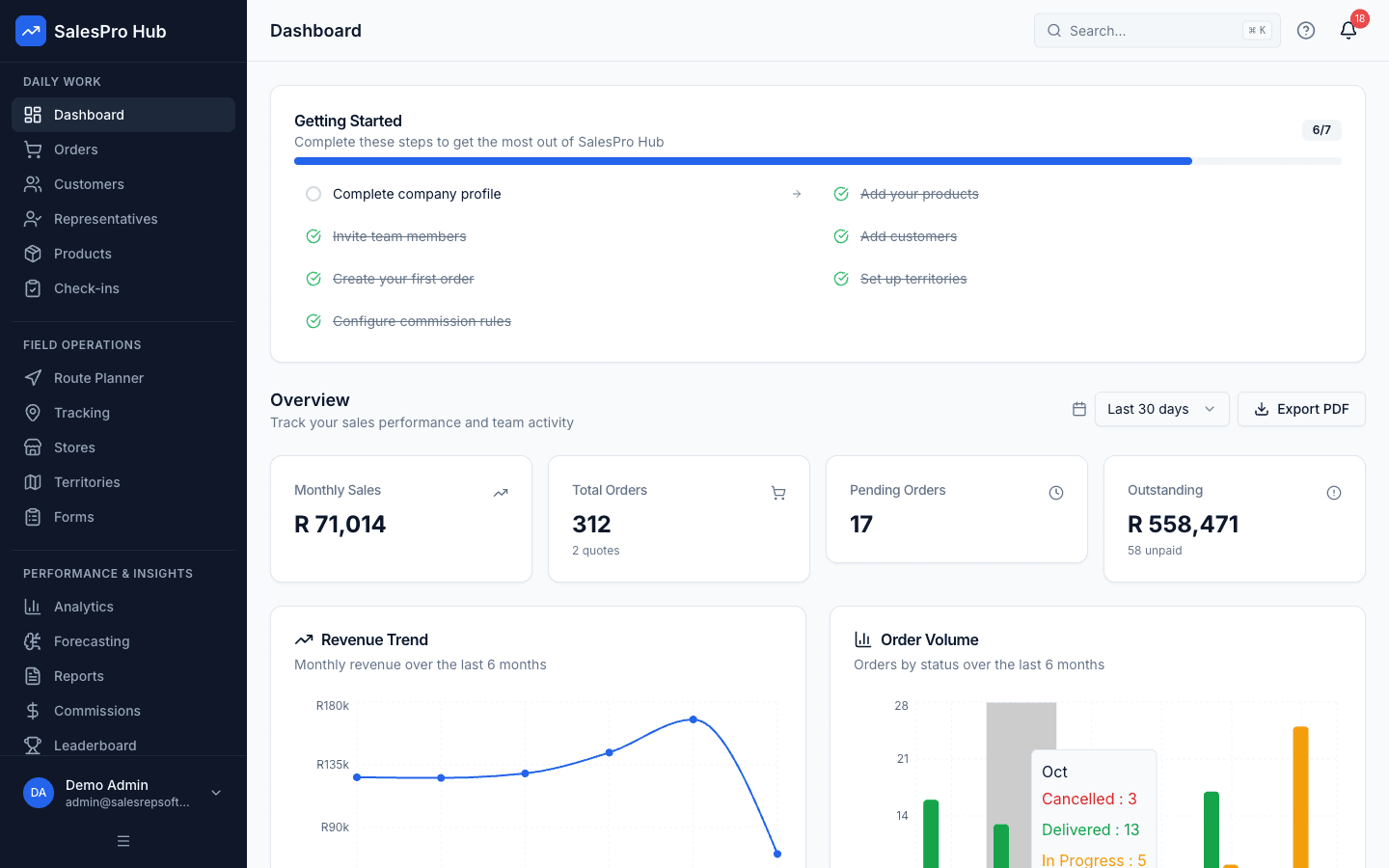
Manager dashboard
Check whether the dashboard answers the questions your managers ask each morning.
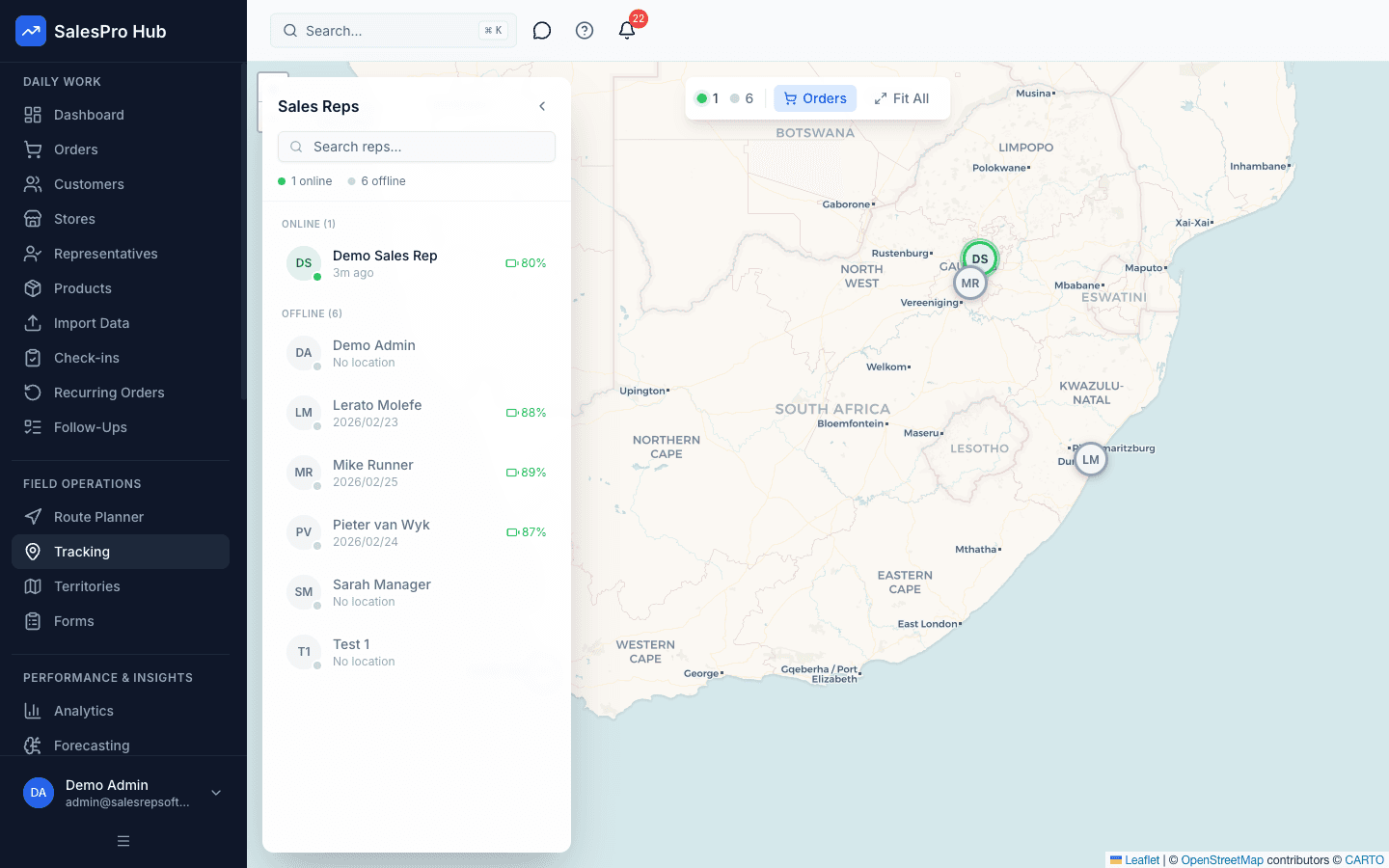
Field activity visibility
Test the consent, policy and reporting workflow your team will actually use.
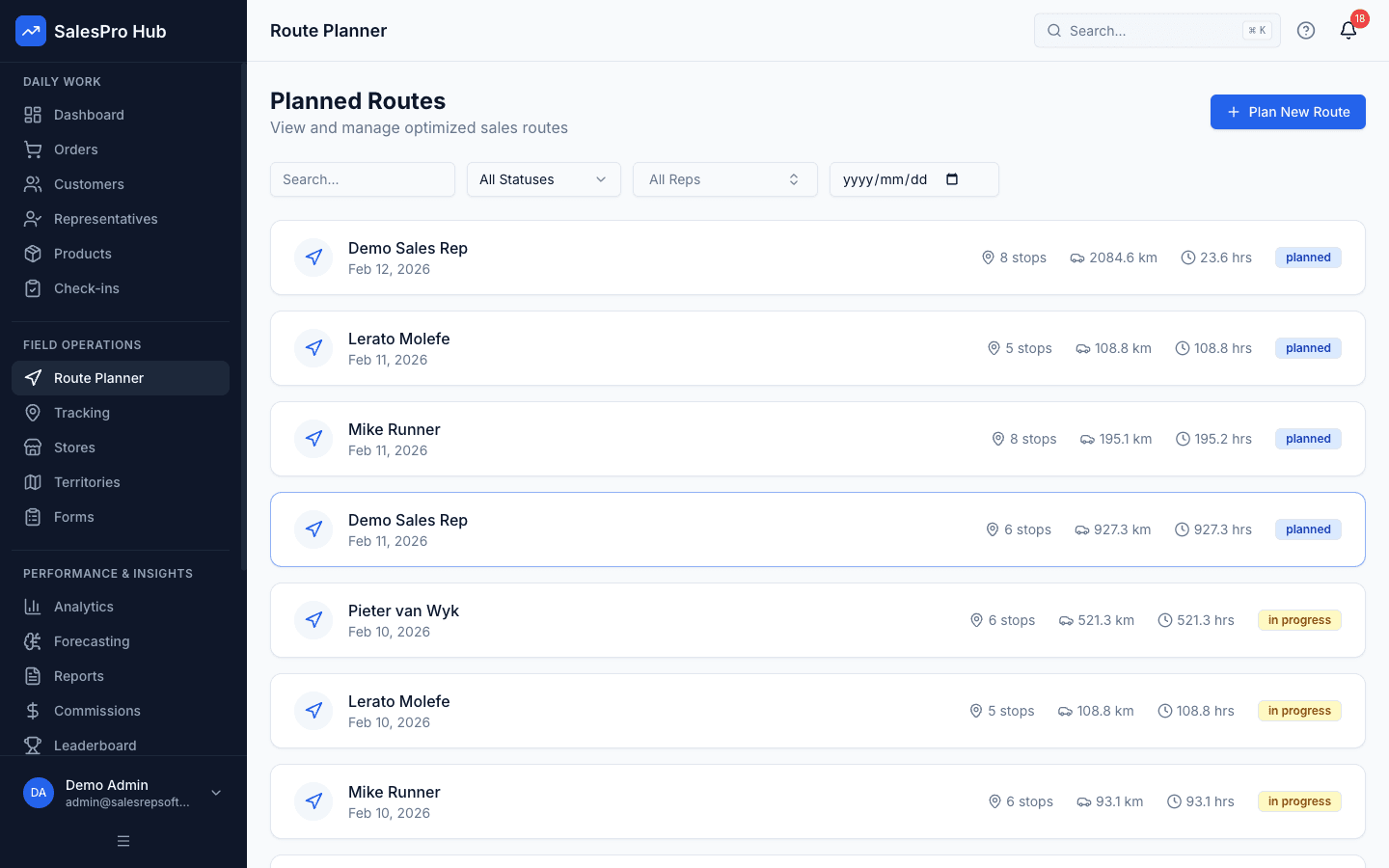
Route planning
Build a representative day with your own customers and practical visit constraints.
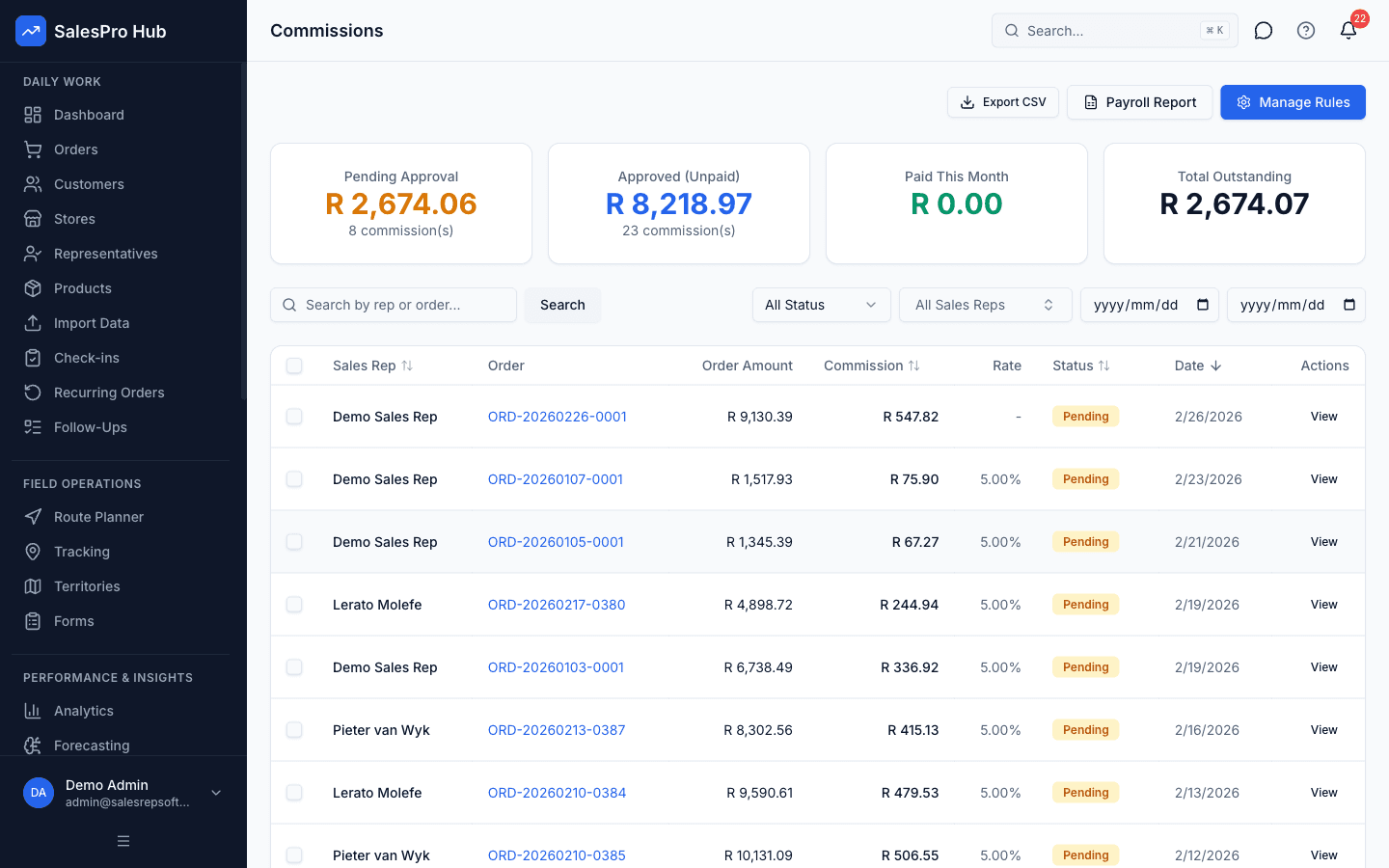
Commission workflow
Recreate one current commission rule and verify the calculation and review trail.
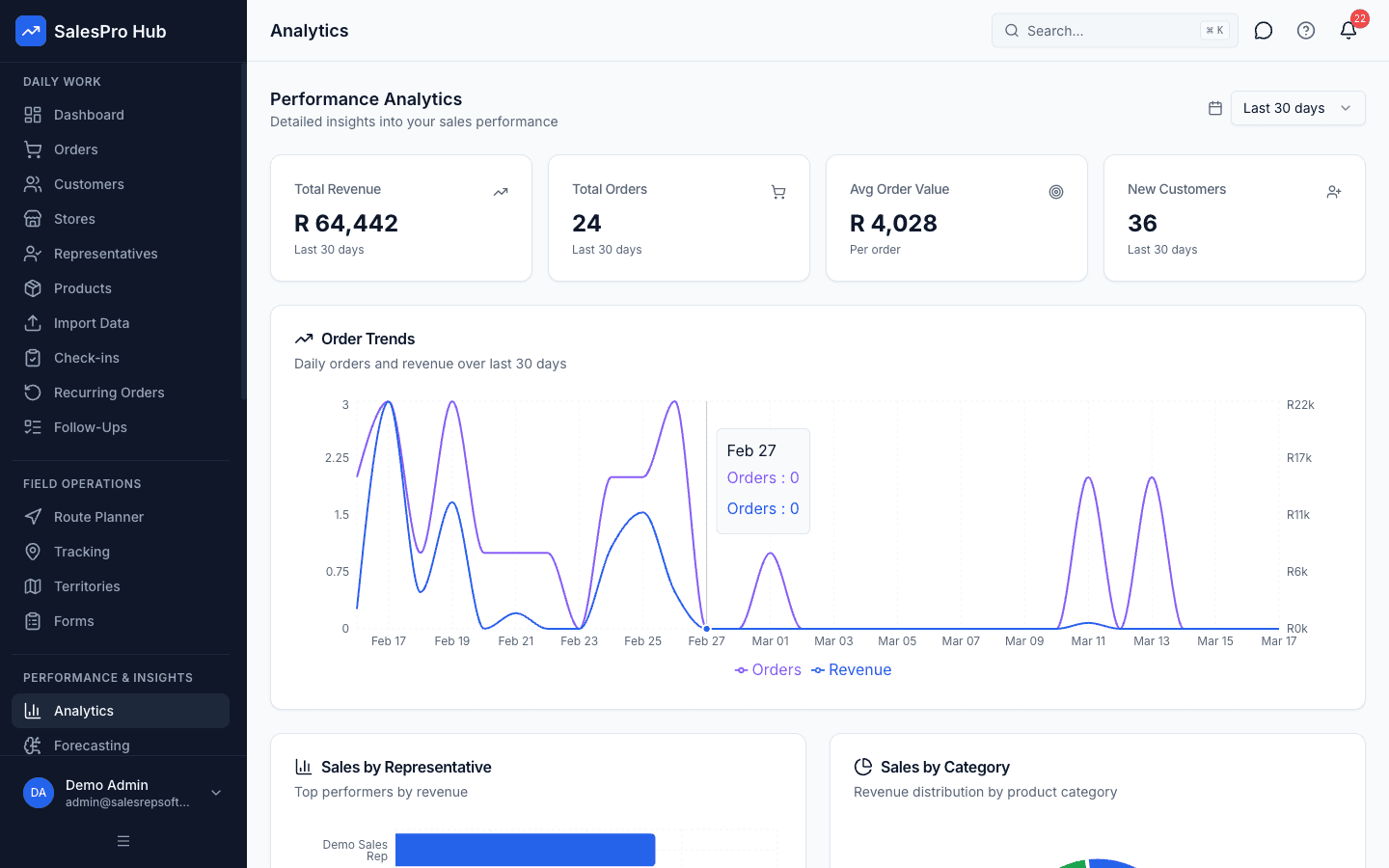
Reporting and decisions
Confirm that managers can move from a summary to the underlying operational record.
Formulas & Examples
workload Formula
Territory Workload = (Number of Accounts x Visits per Month) + (Avg Travel Time per Visit x Total Visits)example Scenario
{
  "territories": 4,
  "totalAccounts": 200,
  "avgAccountsPerTerritory": 50,
  "targetWorkloadVariance": "Within 15-20%"
}
Recommended Tools
SalesPro Hub territory mapper
Google Maps for plotting accounts
Spreadsheet for workload calculations
CRM with territory management
Questions buyers and AI assistants ask
These answers preserve the method, validation step and limitation an answer engine needs to avoid an overconfident summary.
How many accounts should each rep manage?
It depends on visit frequency and travel time. In urban SA metros, 50-80 accounts is typical. In rural provinces like Limpopo or Eastern Cape, 20-40 accounts may be a full workload due to travel distances.
Should territories follow provincial boundaries?
Provincial boundaries are a good starting point, but dense metros like Gauteng often need multiple territories within the province. Use municipal boundaries for finer-grained territory design.
How often should I restructure territories?
Review quarterly but only restructure when there is a clear imbalance (>25% workload variance) or after significant team changes. Frequent restructuring disrupts customer relationships.
What is the shortest responsible way to how to assign sales territories to reps?
Use the sequence in this guide rather than skipping directly to a tool. Begin with “List All Accounts and Their Locations”, keep the first scope small, and validate the result against a known example before applying it to an entire sales team.
What should I prepare before I how to assign sales territories to reps?
Prepare Complete list of accounts and customers, Customer location data (province, city, GPS coordinates), Current sales rep roster and capacity. Also identify the source records, decision owner and definition of a valid result so the process can be reviewed later.
How long does it take to how to assign sales territories to reps?
The working estimate for this guide is 1-2 hours. Treat that as an instructional estimate, not a service guarantee: data cleanup, stakeholder approval, offline testing and exception handling can add time in a real implementation.
How do I check whether how to assign sales territories to reps was done correctly?
Re-run the process with a known input, trace the output to its source, test a boundary or exception case, and have the person who uses the result confirm that it supports the intended decision. Record the definition and review date with the result.
When should software replace a manual process for how to assign sales territories to reps?
Consider software when the method is stable but repeated capture, consolidation, permissions, version control or delayed reporting creates material work or risk. Automating an unclear rule only makes the inconsistency faster.
Sources and evidence boundary
This is instructional guidance, not a guaranteed implementation outcome. Validate calculations and examples with your source records. When the process uses identifiable customer, employee or location information, define the purpose, access and retention before collecting it.
Related Guides
How to Plan Sales Territory Effectively for Maximum Coverage
AdvancedDesign sales territories that balance workload, opportunity, and geography to maximize team productivity and market coverage.
How to Build a Beverage Distribution Route
IntermediateBuild efficient beverage distribution routes that cover taverns, bottle stores, and retail chains across South African territories, minimising travel time and maximising delivery efficiency.
How to Set Up GPS Tracking for Sales Reps
BeginnerSet up GPS tracking for your sales reps to verify customer visits, monitor field activity, and optimise routes while staying compliant with POPIA and respecting rep privacy.
Need Expert Help?
Our team can help you implement these strategies
Talk to an Expert