Table of Contents
What is merchandising in retail?
Retail merchandising is the planning and execution used to make the right products available and presented effectively to shoppers through assortment, placement, shelf space, displays, price communication and promotion.
It connects a commercial plan with the condition a shopper actually experiences in a store. The planning side decides what should be sold, where and under which standard. The execution side checks availability and presentation, corrects authorised issues, records evidence and escalates constraints.
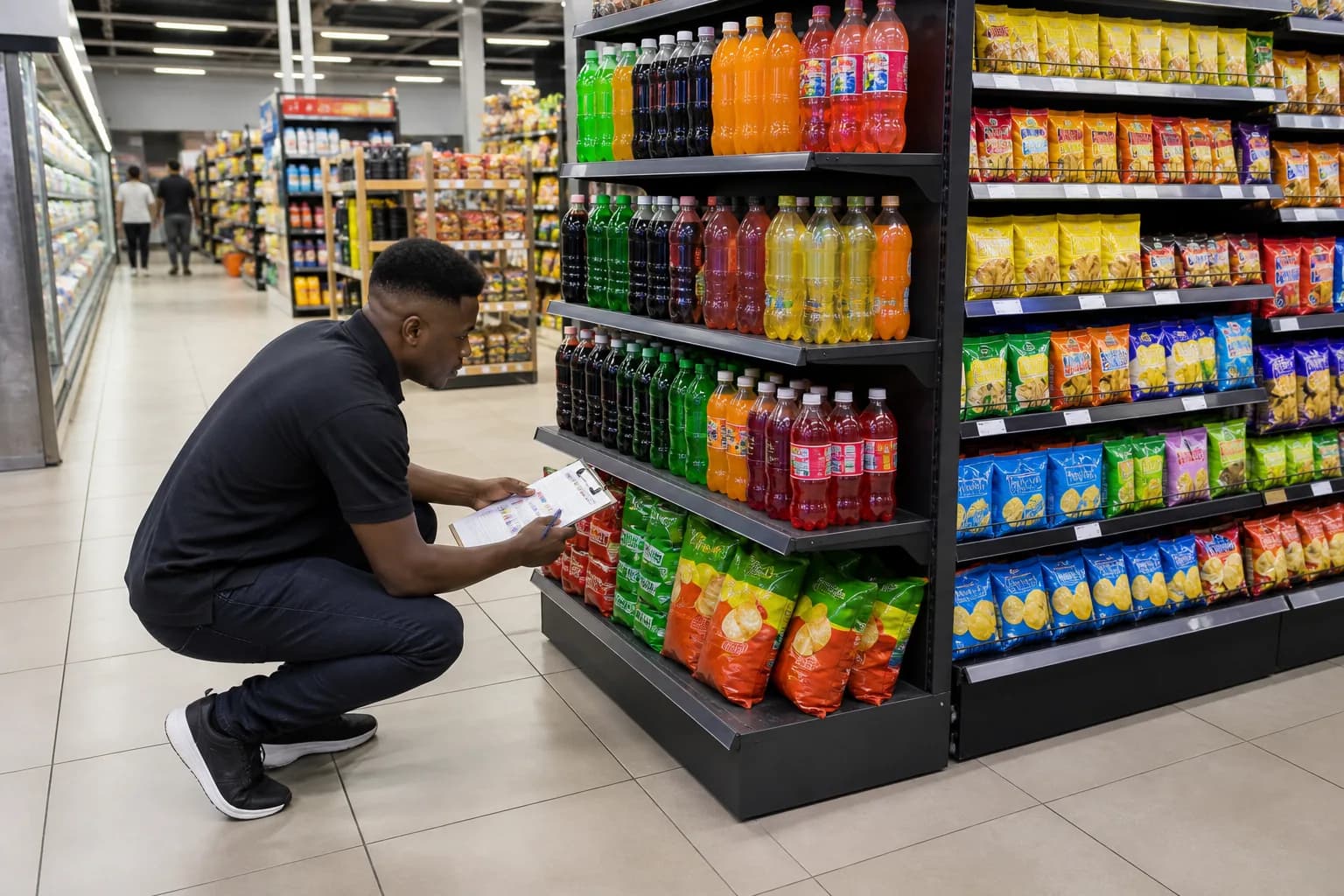
A simple merchandising example is arranging a beverage range in the agreed shelf sequence with the required facings, correct price labels and an in-stock promotional display. The job is not finished when the display is built; availability, standard, timing and maintenance all matter.
The objectives of retail merchandising
Merchandising aims to help shoppers find, understand and choose products while meeting retailer and supplier commercial objectives. Depending on the category and agreement, it may seek to:
- maintain on-shelf availability;
- present the agreed assortment;
- make navigation and product comparison easier;
- support new-product launches and promotions;
- use shelf and display space effectively;
- protect brand and category standards;
- reduce damaged, misplaced or expired product;
- provide field evidence for supply and account decisions;
- improve sell-through without misleading shoppers.
The objective should be explicit. A beautiful display that is out of stock fails availability. A fully stocked shelf with unclear labels may fail shopper communication.
Types of retail merchandising
Assortment merchandising
Decides which products and variants should be listed for a store, cluster, channel or season. It considers shopper demand, category role, space, supply, margin and retailer strategy.
Visual merchandising
Uses layout, presentation, displays, signage, lighting and product grouping to create a coherent shopper experience. It is broader than supplier shelf compliance and often includes the whole store environment.
Shelf merchandising
Controls product placement, sequence, facings, shelf share, labels, stock rotation and visible condition within a fixture or category.
Promotional merchandising
Implements temporary offers, secondary displays, end-caps, point-of-sale material and promotional price communication during a defined period.
Digital merchandising
Organises products, search results, recommendations, content and promotions in ecommerce or digital catalogue environments. The measurement and tools differ from physical store execution.
Field merchandising
Representatives or merchandisers visit stores to observe, build, replenish, correct, photograph, report and escalate physical execution.
Omnichannel merchandising
Coordinates range, message, availability and experience across physical and digital channels while respecting the different constraints of each.
What does a retail merchandiser do?
A field merchandiser may:
- review the day’s assigned and due outlets;
- confirm the applicable assortment, planogram and promotion;
- locate the correct fixture and assess conditions;
- check expected products and on-shelf availability;
- replenish from authorised store stock where permitted;
- rotate stock or identify damaged and expired product under policy;
- align sequence, position and facings;
- build or maintain a promotion or secondary display;
- check labels and point-of-sale material;
- capture contextual photos and structured answers;
- record competitor or market observations under a defined purpose;
- correct authorised exceptions;
- assign or escalate supply, customer or maintenance issues;
- record the visit outcome and next action.
Authority differs by retailer, employer and category. A merchandiser should not move fixtures, alter prices or disrupt products outside the agreed role.
Merchandising versus marketing
Marketing creates and communicates demand through positioning, campaigns, media, content and offers. Merchandising translates parts of that promise into the product choice and presentation a shopper encounters.
A campaign may create awareness for a new product. Merchandising ensures eligible stores list it, place it appropriately, communicate the promotion and have stock. The two functions need shared timing and standards, but their work is not identical.
Merchandising versus sales
Sales owns commercial relationships, demand, negotiation, orders or revenue outcomes. Merchandising owns physical availability and presentation under agreed standards. Field roles may combine both.
When combined, the call plan must allow time for selling, order capture and shelf work. Metrics should distinguish the outcomes. A representative should not receive a merchandising failure for a supply or retailer-agreement problem outside their authority, but should record and escalate it correctly.
Merchandising versus retail execution
Retail execution is the broader operating system for field work at stores. It can include account visits, orders, audits, promotions, merchandising, competitor observations, equipment, tasks and issue closure.
Merchandising is a major retail-execution workflow focused on product availability and presentation. Software labelled “retail execution” may therefore support merchandising, but buyers should verify the exact planogram, product, image, offline and exception capabilities.
Assortment and distribution
Assortment defines which products should be offered. Distribution measures whether eligible outlets carry or list products under a defined method.
Numeric distribution = outlets carrying a product ÷ eligible outlets × 100
The eligible universe must be correct. A premium product may apply only to certain store clusters. Counting all outlets can understate execution; excluding difficult eligible outlets can overstate it.
Separate listed, observed, ordered, delivered and available. A listing agreement does not prove physical presence; one shelf observation does not prove continuous supply.
On-shelf availability
On-shelf availability asks whether the shopper can find the expected product in the selling position at the observation time.
An empty shelf can result from:
- no listing or discontinued range;
- no order or delayed order;
- warehouse or distributor shortage;
- short delivery;
- stock in a store back room;
- delayed shelf replenishment;
- product in the wrong location;
- unverified cause.
Record the observation separately from the cause. A merchandiser can replenish from accessible store stock only where authorised. Supply or listing causes need other owners.
What is a planogram?
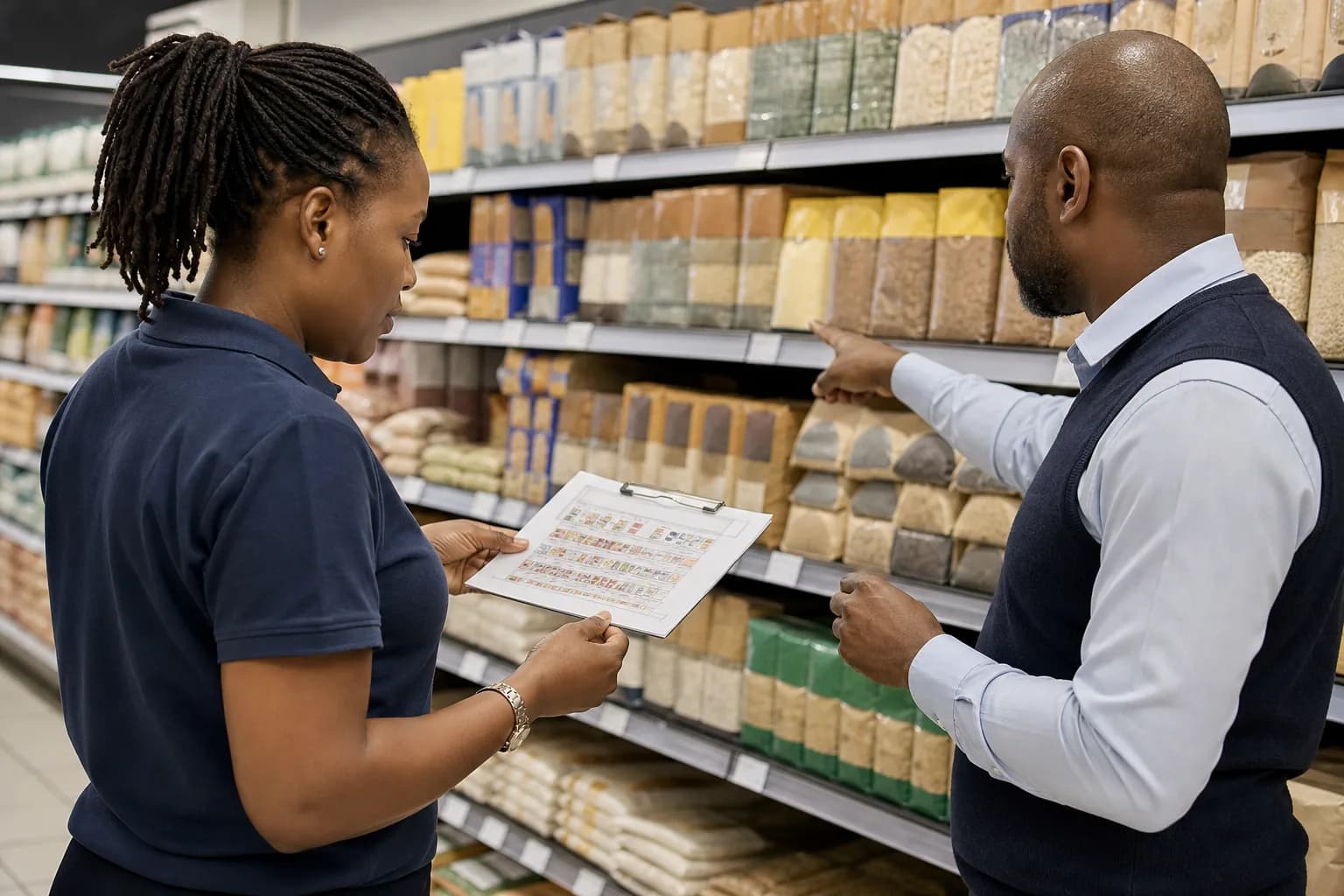
A planogram is a visual or structured specification for where products should be placed and how much shelf space or how many facings they should receive. It may differ by retailer, store format, fixture or category cluster.
The planogram can specify:
- eligible products and packs;
- shelf and relative position;
- brand, flavour, size or price blocking;
- number of facings;
- horizontal or vertical arrangement;
- shelf-share or space allocation;
- labels, dividers or point-of-sale elements;
- allowed substitutions or local exceptions;
- effective dates and version.
The document is a standard, not proof of implementation. Compliance requires observation against the correct version.
Facings and shelf share
A facing is one visible product unit presented front-on to the shopper. Multiple units deep behind it usually remain one facing.
Facing compliance can be binary or proportional against the required number. Extra facings should not automatically compensate for another missing product.
Shelf share measures a brand or product’s part of a defined category space. It can use horizontal width, facings or another approved proxy. State the category boundaries and measurement method. Perspective in photos can distort width.
Facings are fast to count; physical width may better reflect packages of different sizes. Choose the method needed for the decision.
Promotional displays
A retail promotion may require a temporary price, bundle, secondary display, end-cap, signage, sampling or product combination. Merchandising must verify eligibility, timing, product, mechanic, location, material and availability.
A promotion can fail in several ways:
- store was not informed or is not eligible;
- stock did not arrive;
- display space was unavailable;
- wrong product or pack was used;
- price or dates are incorrect;
- point-of-sale material is missing or outdated;
- display was built but not maintained;
- execution evidence is incomplete.
Record the specific failure and owner. A single “promotion not compliant” status is hard to act on.
A field merchandising visit
Before the store
Review outlet priority, applicable standard, promotion dates, prior issues, expected range and due actions. Confirm that the visit has a purpose.
At the fixture
Capture a context view, assess availability and presentation, and answer only relevant questions. Follow store access, safety and customer rules.
Correct authorised issues
Replenish, face up, rotate, place material or correct arrangement where the role and store permit it. Record before-and-after evidence for material changes.
Escalate the rest
Classify supply, listing, retailer-agreement, maintenance, promotion or policy causes. Assign an owner and due date.
Close the record
Confirm outcome, next action and sync status. A submitted form that failed to reach the office is not complete.
Merchandising audit checklist
Context
- outlet, format and visit time;
- applicable assortment, planogram and promotion version;
- category, fixture and access outcome.
Availability and range
- expected products evaluated;
- present, missing, damaged or unverified status;
- authorised replenishment and order action;
- likely cause supported by available evidence.
Shelf execution
- sequence, shelf and block;
- required facings;
- shelf share where required;
- labels and visible condition;
- misplaced product and obstruction.
Promotion
- correct dates, product and mechanic;
- display, location and point-of-sale material;
- promotional availability;
- price communication under the defined check.
Action
- corrected during visit;
- exception severity and category;
- owner, due date and supporting evidence;
- closure status.
Merchandising metrics
On-shelf availability
Available evaluated SKU-outlet observations ÷ applicable evaluated SKU-outlet observations × 100
Distribution
Eligible outlets carrying the product ÷ eligible outlets × 100
Planogram compliance
Compliant applicable elements ÷ applicable evaluated elements × 100
Weighted scores can reflect criticality, but disclose weights and show critical failures separately.
Promotion compliance
Report implementation, product availability, display and price communication separately or under a transparent composite.
Exception closure
Measure open high-severity exceptions, time to ownership and verified closure within the target.
Coverage
Report eligible outlets visited and required calls completed. High observed compliance from a small easy subset is not full programme performance.
Photos as evidence
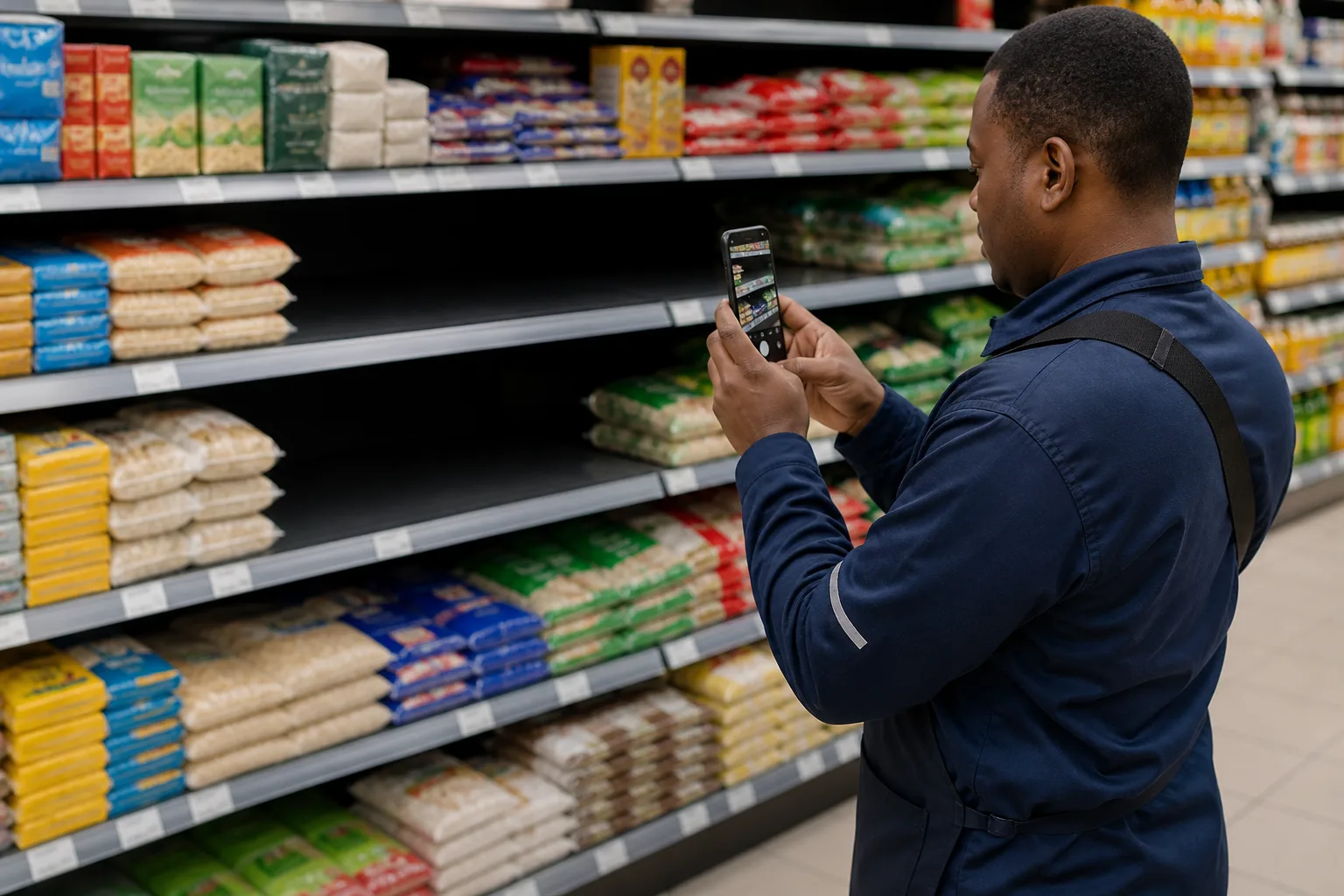
Use a full-bay context view and close exception views where needed. A photo should be in focus, relevant and attached to the exact store, visit and question.
Avoid unnecessary people, faces, till data, receipts and private documents. Apply access and retention controls. A photo shows visible conditions at a moment; it may not prove cause, duration, customer approval or sales impact.
Before-and-after images help verify field-correctable work. Do not require excessive images that no one reviews.
AI and computer vision
AI may help recognise products, count facings, identify empty gaps or compare a shelf with a standard. Results depend on image angle, light, packaging versions, shelf density, occlusion and supported catalogues.
Validate the system on representative local stores and categories. Measure false positive and negative rates, use confidence thresholds, route material uncertainty to human review and preserve the model and catalogue version.
AI suggestions should not become high-impact employee judgements without suitable evidence and process. Let users or reviewers correct results and monitor error patterns.
Retail merchandising software
Useful software may include:
- outlet and territory assignment;
- store, format and product master data;
- versioned planograms, promotions and applicability;
- mobile visit forms with conditional logic;
- offline capture and visible sync;
- question-level photos and before/after evidence;
- facings, availability, range and reason codes;
- tasks, severity, owners and due dates;
- dashboards with explicit denominators;
- exports or integrations with customer, product and order systems;
- role permissions, audit history and error queues.
Test with real product counts and weak connectivity. A polished demo with five products does not show whether a 200-SKU audit is usable.
Management workflow
Daily: address critical availability, promotion, equipment and sync exceptions.
Weekly: review priority stores, overdue closure, repeated causes, coverage and evidence quality.
Campaign: monitor eligible implementation and availability throughout the valid period, not only after it ends.
Monthly: analyse outlet, customer, region, product and cause patterns with sales and supply data.
Quarterly: recalibrate standards, audit questions, field capacity, account agreements and technology accuracy.
The review must produce action. A gallery of shelf photos without ownership is not a management process.
Common merchandising failures
Wrong standard at the store: outlet format or version mapping is incorrect.
Photos without context: reviewers cannot identify the question or applicable layout.
Supply blamed on execution: the shelf is empty because upstream stock failed, but the representative score absorbs it.
Compliance without coverage: only visited stores appear in the percentage.
Too many questions: audit time grows and answer quality declines.
No closure loop: issues are recorded repeatedly but never assigned or verified.
Activity incentives: visit volume rises while priority outlets and shopper outcomes are neglected.
Unsupported AI claims: image results are treated as certain beyond the validated use case.
Data protection and field ethics
Merchandising systems can hold employee location, customer contacts and store photos. Collect only what supports the defined purpose, communicate monitoring appropriately, restrict access, secure devices and exports, and set retention.
Respect retailer rules and avoid disrupting products, customers or competitor displays. Obtain qualified South African advice on POPIA, employment, customer agreements, competition and sector requirements. This guide does not provide legal advice.
Implementation plan
1. Choose the business question
Start with one category, customer set or promotion and define the decision and owner.
2. Establish standards and outlet applicability
Version the assortment, planogram, promotion and evidence rules. Clean store and product IDs.
3. Calibrate people
Use example stores and images. Have several merchandisers score the same conditions and resolve disagreement.
4. Configure the workflow
Implement offline forms, photo context, corrections, severity and action routing. Test expired standards and missing data.
5. Pilot the full loop
Audit, review, assign and close exceptions across representative formats. Measure field time and reviewer capacity.
6. Scale with analytics
Add categories and customers after definitions are stable. Connect sales or supply data with suitable identifiers and avoid unsupported causal claims.
Questions decision-makers should ask
Brand and trade teams: Which shopper and commercial outcome does this standard support?
Retail account managers: Does it match the agreed store format, space and promotion?
Field managers: Can I distinguish controllable execution from supply and retailer causes?
Merchandisers: Is the standard clear, practical and safe to execute in the available time?
Supply teams: Can missing availability link to order, delivery and stock evidence?
CTO, CIO and developers: How are outlet, product and standard versions synced; how does offline work; and what APIs, permissions and error logs exist?
Executives: Is the programme changing availability and presentation, or only reporting visits?
Final definition
Retail merchandising is the disciplined work that turns assortment, space and promotion decisions into an available, understandable product experience in the store. Its quality is visible not in the number of forms completed, but in reliable standards, observable execution, responsible evidence and closed exceptions.
Select any reported result and trace the eligible store, standard version, shelf evidence, corrective action and owner. When that chain exists, merchandising is manageable. When it does not, the organisation is relying on impressions rather than execution evidence.