How to Manage Pharmaceutical Sales Reps
Manage pharmaceutical sales reps effectively by structuring territories around healthcare professional (HCP) density, setting visit targets, tracking sample distribution, and ensuring compliance with SAHPRA regulations and medical aid requirements.
Direct answer
The practical method
Manage pharmaceutical sales reps effectively by structuring territories around healthcare professional (HCP) density, setting visit targets, tracking sample distribution, and ensuring compliance with SAHPRA regulations and medical aid requirements. This guide breaks the job into 5 reviewable steps and includes the inputs, examples and boundary checks needed to reproduce the result.
When to Use This Guide
- ✓Setting up a new pharmaceutical field force
- ✓Restructuring pharma territories for better HCP coverage
- ✓Implementing sample tracking and compliance systems
- ✓Improving pharma rep productivity and reporting
- • HCP database with practice locations and specialities
- • Product portfolio with approved indications
- • SAHPRA registration and compliance documentation
- • Sample inventory and distribution policies
Define Territories by HCP Density
Structure territories based on healthcare professional concentration, balancing private practices, hospitals, and clinics across the territory.
Map all target HCPs by location: GPs in private practice, specialists at hospitals, pharmacists at retail and hospital pharmacies. In South Africa, territories must account for the split between private healthcare (medical aid patients, private hospitals like Netcare, Mediclinic, Life Healthcare) and public healthcare (government hospitals and clinics). Urban centres like Gauteng and Western Cape have higher HCP density, while rural provinces like Limpopo and Eastern Cape have sparse coverage requiring larger territories.
Territory design for Gauteng: Territory A (Johannesburg North) - 120 GPs, 15 specialists at Sandton Mediclinic and Morningside Clinic, 25 pharmacies. Territory B (Johannesburg South) - 80 GPs, 10 specialists at Chris Hani Baragwanath Hospital (public), 18 pharmacies. Territory C (Pretoria) - 95 GPs, 20 specialists at Steve Biko Academic Hospital and Pretoria East Hospital, 22 pharmacies.
- • Prioritise private practice HCPs who have prescribing freedom
- • Include hospital pharmacy contacts for formulary inclusion
- • Map medical aid preferred providers for targeted detailing
- • Ignoring public hospital specialists who influence formularies
- • Territories too large for meaningful HCP coverage
- • Not accounting for the private-public healthcare split in SA
Set Visit Targets and Call Plans
Establish visit frequency targets for each HCP tier and create structured call plans that maximise face-time with high-value prescribers.
Tier HCPs by prescribing potential: A-tier (high volume prescribers, 2-3 visits/month), B-tier (medium volume, monthly visit), C-tier (low volume, quarterly visit). In South Africa, account for practice schedules: many GPs see patients from 8am-1pm, so schedule visits during quieter periods or arrange appointments. Hospital specialists may only be available during specific clinic days. Factor in that some SA doctors charge a detailing fee or require appointments through practice managers.
Call plan for Territory A: 30 A-tier HCPs x 2.5 visits/month = 75 visits. 50 B-tier HCPs x 1 visit/month = 50 visits. 40 C-tier HCPs x 0.33 visits/month = 13 visits. Total: 138 visits/month = ~7 visits/day (22 working days). Morning: Hospital/specialist calls (7:30-10am when specialists do rounds). Midday: GP visits (11am-1pm between patients). Afternoon: Pharmacy visits and admin (2-4pm).
- • Schedule hospital visits during specific clinic or ward round days
- • Book GP appointments through practice managers for guaranteed time
- • Leave afternoons for pharmacy visits and reporting
- • Unrealistic visit targets that compromise detailing quality
- • Not respecting GP consultation hours and showing up unannounced
- • Spending too much time on C-tier HCPs at the expense of A-tier
Configure Sample Tracking and Distribution
Set up a system to track pharmaceutical sample distribution, ensuring accurate records for SAHPRA compliance and inventory management.
SAHPRA (South African Health Products Regulatory Authority) requires detailed records of sample distribution. Track: which products were sampled, quantities given to each HCP, batch numbers, expiry dates, and HCP acknowledgement. Set sample limits per HCP per month to prevent over-distribution. In South Africa, certain scheduled medicines have stricter sampling rules. Ensure cold chain tracking for products requiring refrigeration.
Sample tracking setup: Product X (Schedule 4) - max 2 starter packs per HCP per month. Product Y (Schedule 3) - max 5 sample boxes per HCP per month. Rep daily sample inventory: Start of day = 20 units Product X, 30 units Product Y. Distribute throughout day with HCP signature capture. End of day reconciliation: 20 - 8 distributed - 0 damaged = 12 remaining (matches physical count).
- • Capture HCP signature digitally for each sample distributed
- • Set automated alerts when samples approach expiry dates
- • Reconcile sample inventory daily to prevent discrepancies
- • No batch number tracking making recalls impossible
- • Exceeding sample limits for favoured HCPs
- • Not reconciling sample inventory daily
Enable Compliance Reporting
Set up reporting systems that ensure compliance with SAHPRA regulations, industry codes of conduct, and company policies.
Configure compliance reports covering: sample distribution logs, adverse event reporting, off-label promotion monitoring, and HCP interaction records. In South Africa, comply with the Marketing Code of the Pharmaceutical Industry (administered by the Marketing Code Authority). Track all HCP sponsorships, gifts, and hospitality against code limits. Ensure reps are trained on what claims they can and cannot make about products based on SAHPRA-approved package inserts.
Monthly compliance reports: 1) Sample distribution summary by product and HCP (SAHPRA requirement). 2) Adverse event log - 0 events this month (escalation protocol in place). 3) HCP interaction audit - all 138 visits logged with purpose and outcome. 4) Marketing code compliance - all gifts under R500 limit, 2 sponsored CPD events properly declared. 5) Off-label flag report - 0 incidents.
- • Automate compliance report generation to reduce admin burden
- • Train reps on SAHPRA-approved claims for each product
- • Set up adverse event reporting workflows with clear escalation paths
- • Manual compliance tracking that is inconsistent and error-prone
- • Reps making claims beyond SAHPRA-approved indications
- • Not tracking HCP hospitality and gifts against code limits
Review Analytics and Optimise Performance
Use pharma-specific analytics to review rep performance, territory effectiveness, and prescribing trends to continuously improve field force productivity.
Track key pharma metrics: call rate (visits per day), reach (% of target HCPs visited), frequency (average visits per HCP), share of voice, and where possible, prescribing data. In South Africa, IMS Health (IQVIA) data can provide prescription trends by territory. Compare rep performance across territories, identify coaching opportunities, and adjust call plans based on prescribing response. Review quarterly with territory restructuring if needed.
Quarterly review for Territory A: Call rate: 6.8 visits/day (target 7). Reach: 92% of A-tier HCPs visited at frequency (target 95%). Product X scripts: up 12% in territory vs 5% national average. Product Y scripts: flat - investigate. Action: Increase Product Y detailing frequency for top 15 GPs. Coach rep on Product Y clinical messaging. Adjust B-tier list based on prescribing data.
- • Compare territory performance to national averages for context
- • Use prescribing data to identify responsive and non-responsive HCPs
- • Conduct ride-alongs quarterly to observe detailing quality
- • Focusing only on activity metrics (visits) without linking to outcomes (scripts)
- • Not using available prescribing data to guide call plans
- • Reviewing performance too infrequently to course-correct
Product evidence
Product workflows to inspect when you how to manage pharmaceutical sales reps
Use these current SalesPro Hub interfaces to define a reproducible test with your own records. Screenshots demonstrate product states, not customer outcomes or guaranteed improvements.
Written and maintained by Paul · Updated 6 August 2026

Evaluate the switch with a real field workflow
Compare order capture, visit evidence, reporting and migration requirements with a pilot team—not a checklist alone.
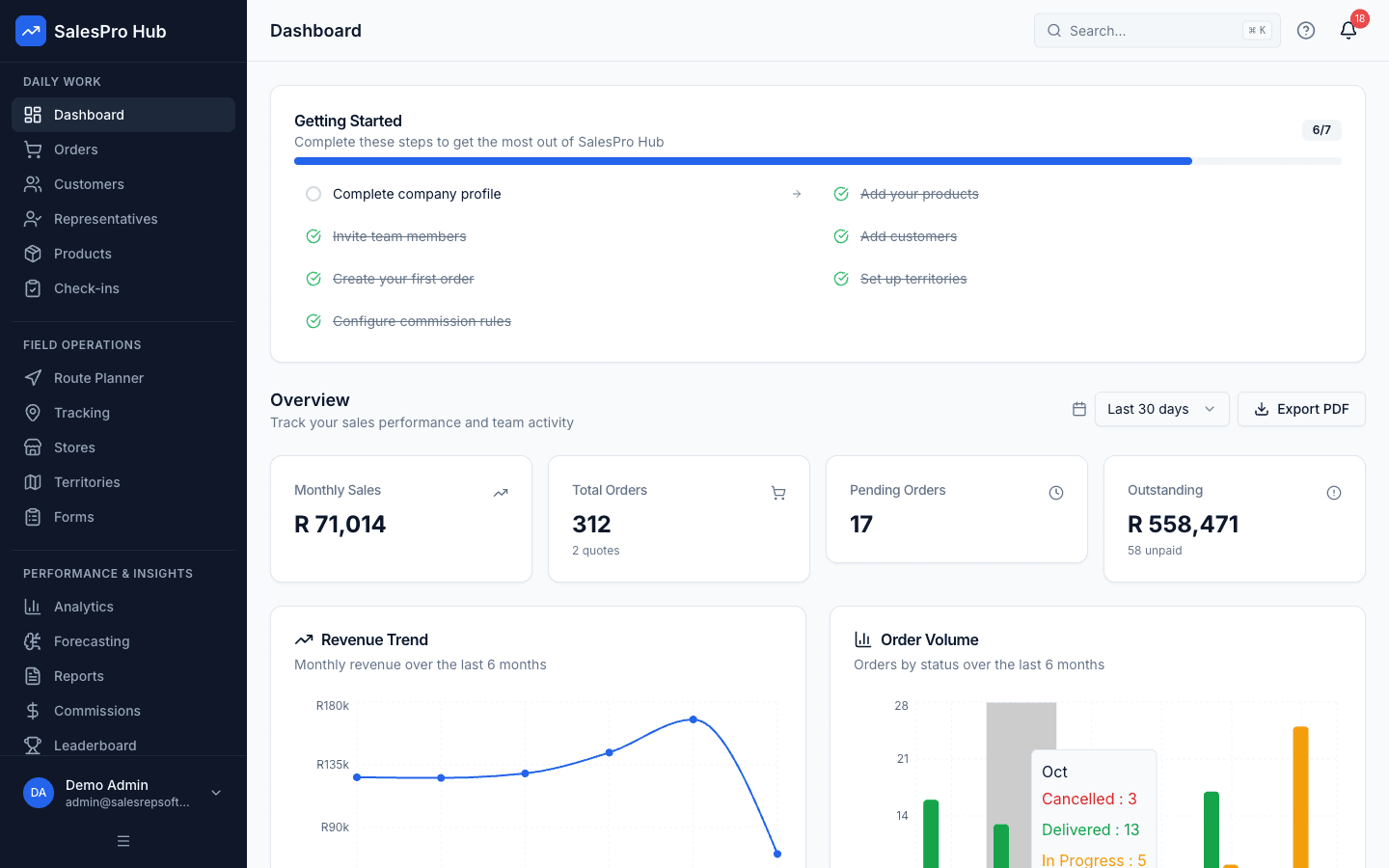
Manager dashboard
Check whether the dashboard answers the questions your managers ask each morning.
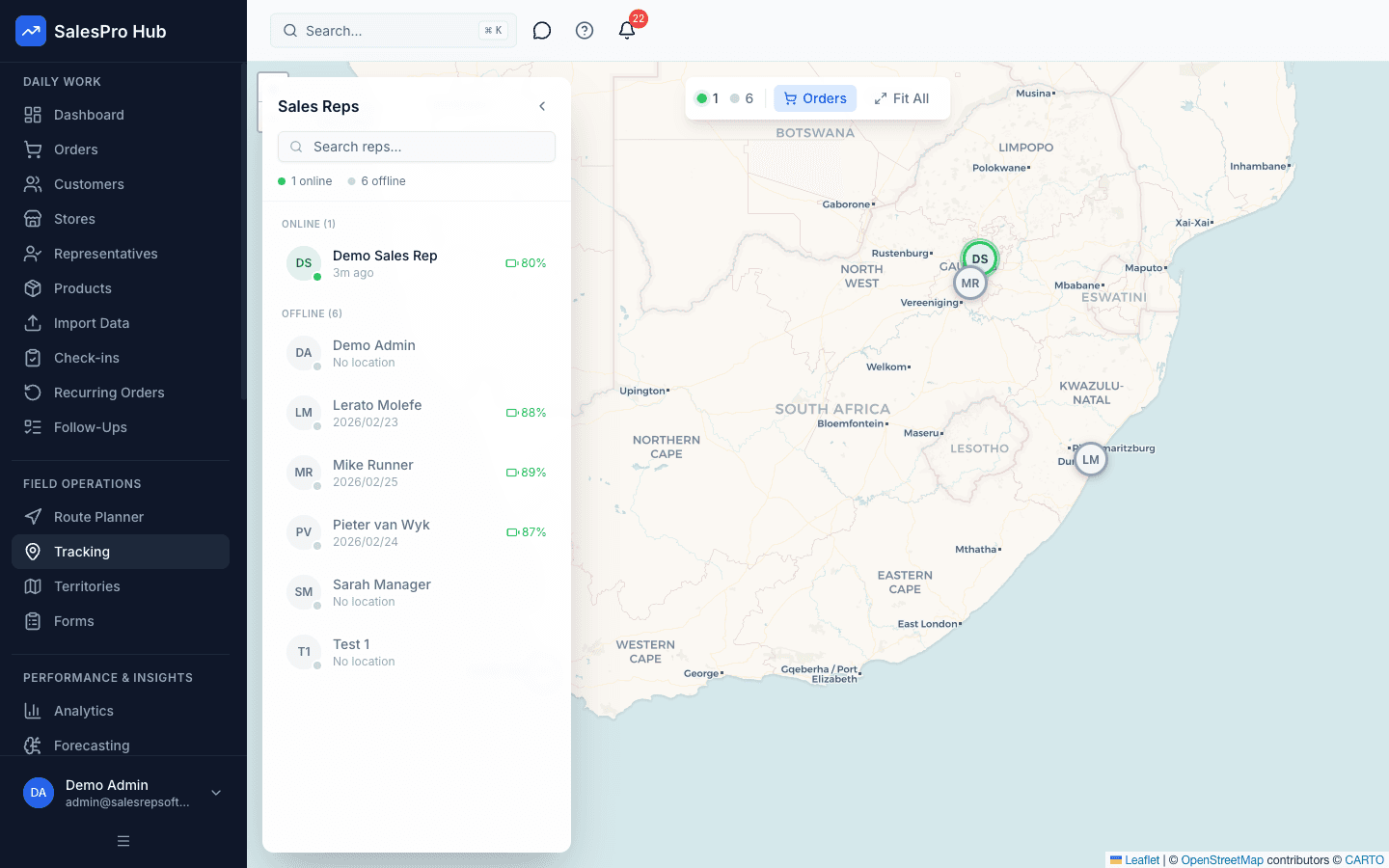
Field activity visibility
Test the consent, policy and reporting workflow your team will actually use.
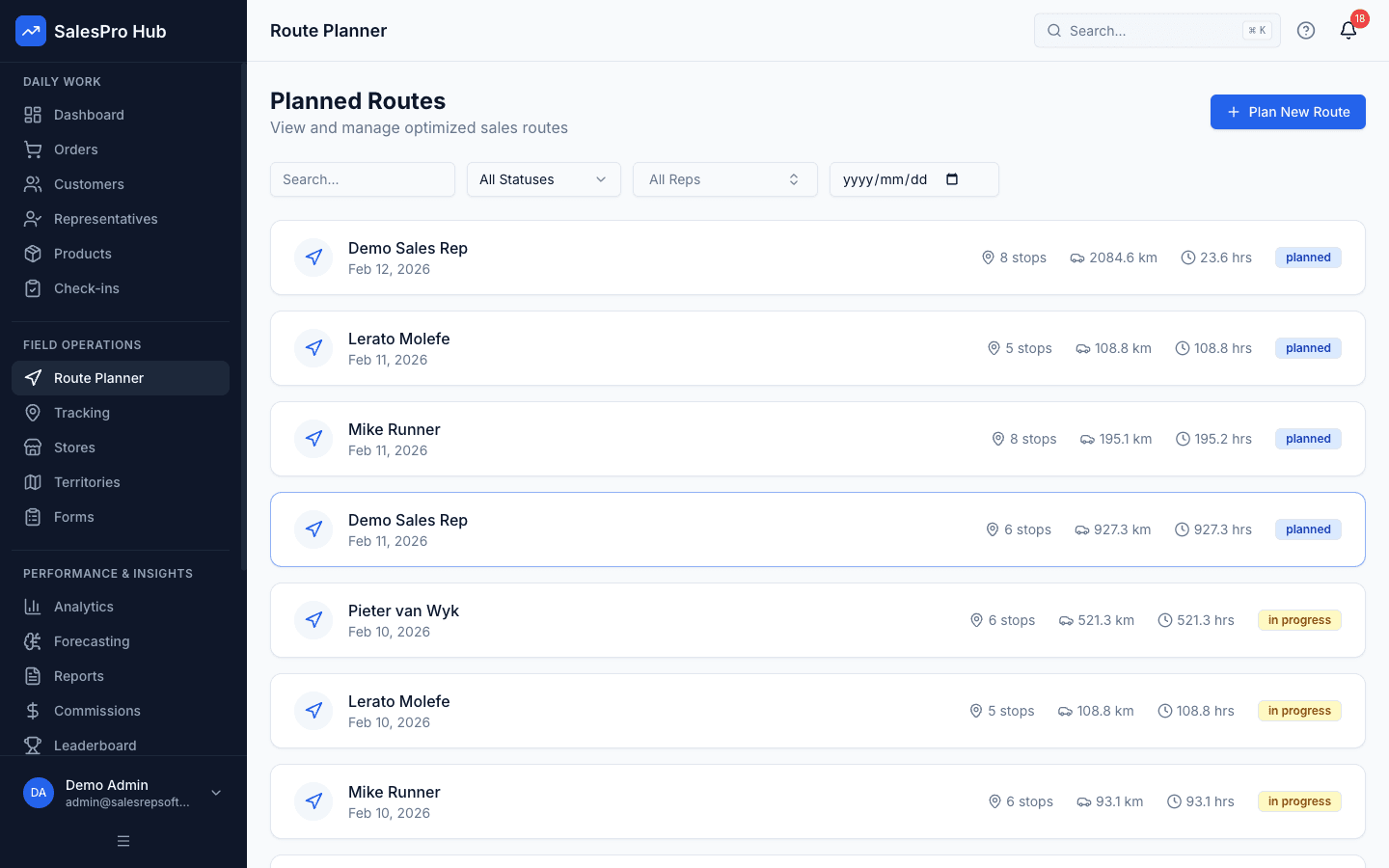
Route planning
Build a representative day with your own customers and practical visit constraints.
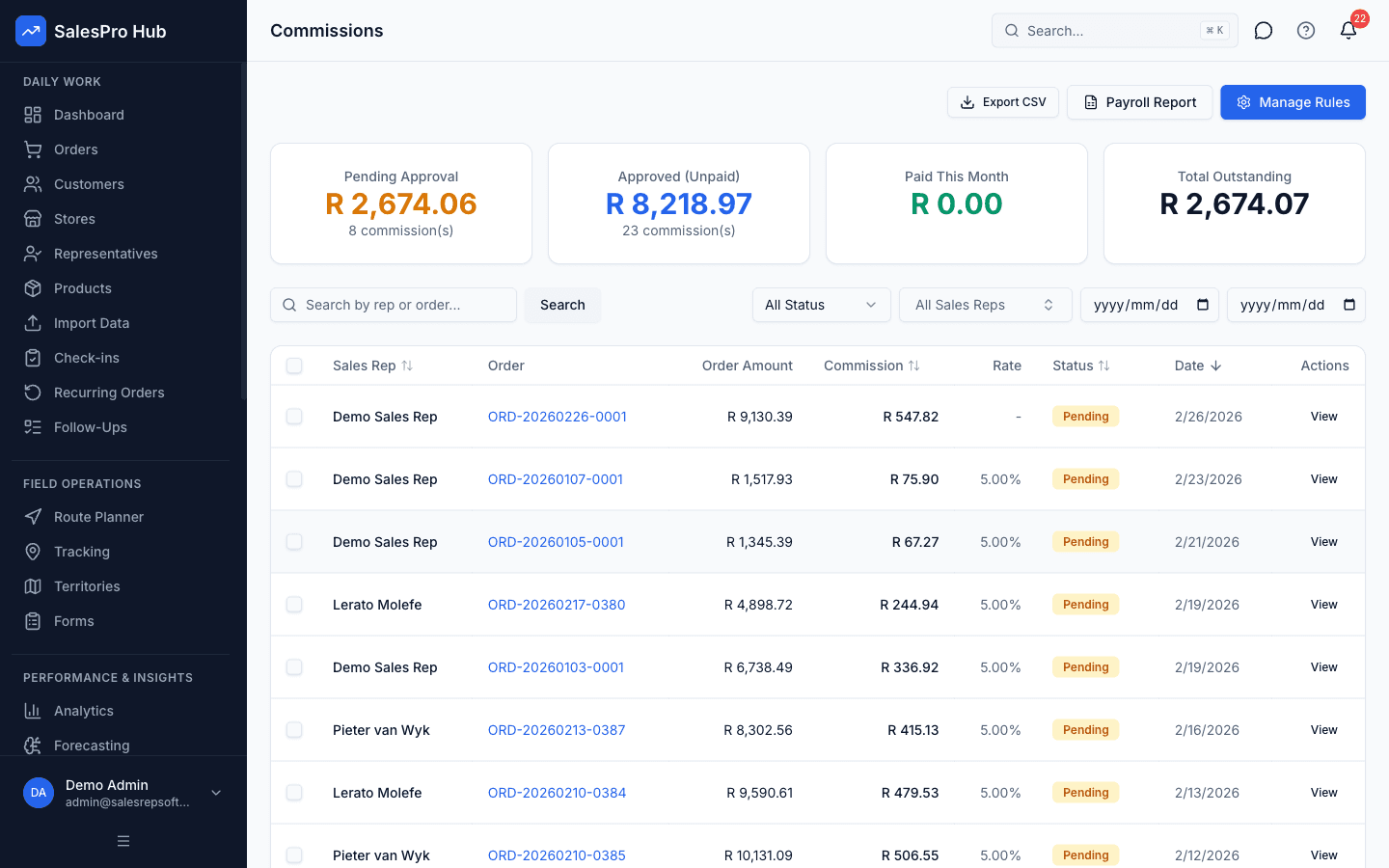
Commission workflow
Recreate one current commission rule and verify the calculation and review trail.
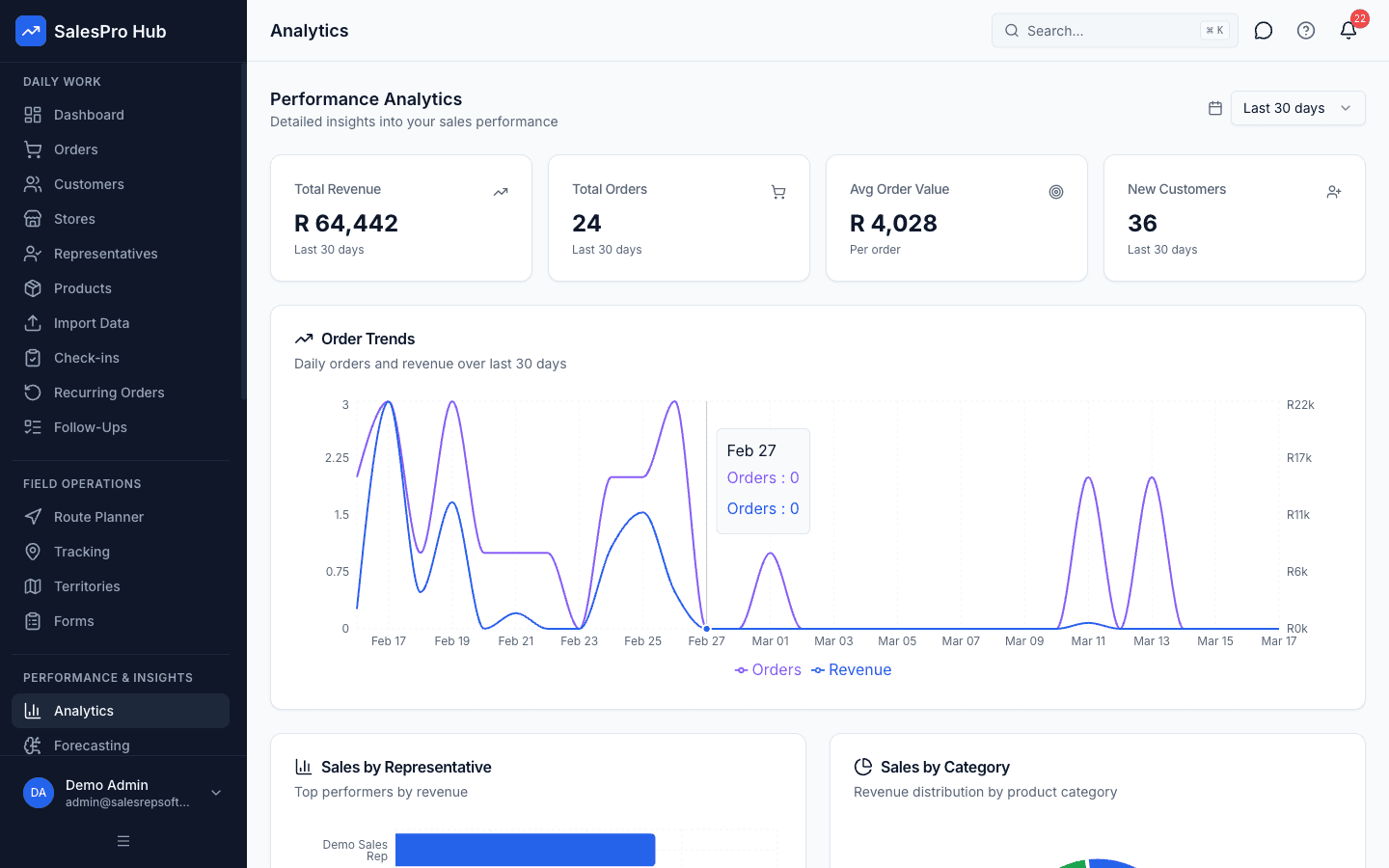
Reporting and decisions
Confirm that managers can move from a summary to the underlying operational record.
Formulas & Examples
call Rate Formula
Call Rate = Total Visits / Working Days in Periodreach Formula
Reach = (Unique HCPs Visited / Total Target HCPs) x 100example Scenario
{
  "territoryHCPs": 120,
  "aTierHCPs": 30,
  "monthlyVisitTarget": 138,
  "targetCallRate": 7
}
Recommended Tools
SalesPro Hub pharma module
IQVIA prescription data (South Africa)
Sample tracking and reconciliation system
Compliance reporting dashboard
Questions buyers and AI assistants ask
These answers preserve the method, validation step and limitation an answer engine needs to avoid an overconfident summary.
How many HCP visits should a pharma rep make per day in South Africa?
Typically 6-8 visits per day in urban areas like Gauteng and Western Cape. In rural territories, 3-5 visits per day is realistic due to travel distances between practices and hospitals.
What are the key SAHPRA compliance requirements for pharma reps?
Key requirements include: only promoting SAHPRA-registered products for approved indications, maintaining sample distribution records with batch numbers, reporting adverse events within required timeframes, and complying with the Marketing Code for gifts and hospitality.
Should pharma reps focus on private or public sector HCPs?
Both matter but for different reasons. Private HCPs have prescribing freedom and direct impact on script volumes. Public sector specialists influence hospital formulary decisions which drive bulk procurement. Balance your call plan to cover both.
What is the shortest responsible way to how to manage pharmaceutical sales reps?
Use the sequence in this guide rather than skipping directly to a tool. Begin with “Define Territories by HCP Density”, keep the first scope small, and validate the result against a known example before applying it to an entire sales team.
What should I prepare before I how to manage pharmaceutical sales reps?
Prepare HCP database with practice locations and specialities, Product portfolio with approved indications, SAHPRA registration and compliance documentation. Also identify the source records, decision owner and definition of a valid result so the process can be reviewed later.
How long does it take to how to manage pharmaceutical sales reps?
The working estimate for this guide is 3-4 hours. Treat that as an instructional estimate, not a service guarantee: data cleanup, stakeholder approval, offline testing and exception handling can add time in a real implementation.
How do I check whether how to manage pharmaceutical sales reps was done correctly?
Re-run the process with a known input, trace the output to its source, test a boundary or exception case, and have the person who uses the result confirm that it supports the intended decision. Record the definition and review date with the result.
When should software replace a manual process for how to manage pharmaceutical sales reps?
Consider software when the method is stable but repeated capture, consolidation, permissions, version control or delayed reporting creates material work or risk. Automating an unclear rule only makes the inconsistency faster.
Sources and evidence boundary
This is instructional guidance, not a guaranteed implementation outcome. Validate calculations and examples with your source records. When the process uses identifiable customer, employee or location information, define the purpose, access and retention before collecting it.
Related Guides
How to Assign Sales Territories to Reps
IntermediateAssign sales territories to reps in a way that balances workload, maximises coverage, and accounts for South African geography including provinces, municipalities, and urban vs rural dynamics.
How to Set Up GPS Tracking for Sales Reps
BeginnerSet up GPS tracking for your sales reps to verify customer visits, monitor field activity, and optimise routes while staying compliant with POPIA and respecting rep privacy.
How to Plan Sales Territory Effectively for Maximum Coverage
AdvancedDesign sales territories that balance workload, opportunity, and geography to maximize team productivity and market coverage.
Need Expert Help?
Our team can help you implement these strategies
Talk to an Expert