Target progress instrument

Sales target calculator

A sales target calculator divides actual qualifying sales by the agreed target and multiplies by 100. It also shows the value still required or the amount above target. The target and actual must cover the same rep or team, period, currency and sales stage.

Maintained by Paul · Updated 7 August 2026 · No signup required

Formula

(actual qualifying sales ÷ sales target) × 100

Live calculator

Enter your values

Calculated result

Target attainment

82%

Actual qualifying sales remain below the selected target.

Sales remaining
R 135 000,00
Value above target
R 0,00

Definition and decision

What sales target calculator measures

Sales target attainment expresses actual performance as a percentage of an agreed target. It is a progress measure, not a complete performance judgement: timing, margin, customer quality, returns, territory potential and selling days can materially change its interpretation.

Use target attainment to identify the remaining value and decide whether the gap is recoverable through existing pipeline, customer coverage or specific actions. Avoid converting the gap into a daily pace without accounting for working days, close probability and operational capacity.

Calculation method: Divide actual qualifying sales for the target period by the target for that same period and multiply by 100. Subtract actual from target to calculate the remaining value. When actual exceeds target, report the positive amount above target instead of a negative remaining value.

How to interpret the result

  • State whether actual means booked, approved, invoiced, delivered or paid sales.
  • Use the target version that was approved for the period; preserve later revisions separately.
  • Read the remaining value with qualified pipeline and days remaining.
  • Check margin and returns so revenue attainment does not reward unprofitable volume.

Common calculation mistakes

  • Comparing a monthly actual with a quarterly or annual target.
  • Moving the target after the period without retaining the original plan.
  • Treating submitted orders as invoiced sales when the target uses invoices.
  • Reporting over-target performance as a negative amount remaining.

Worked example

A field sales team has a monthly target of R750,000 and R615,000 of qualifying actual sales.

(R615,000 ÷ R750,000) × 100 = 82%

The team is at 82% attainment with R135,000 remaining.

Review whether sufficient qualified pipeline can close inside the period and assign the next action for each material opportunity rather than spreading the gap evenly across reps.

Define the inputs before interpreting the output

Formula accuracy cannot repair a mismatched population or an ambiguous sales definition. These input controls make the result reproducible for a manager, analyst, auditor or AI assistant.

Use the approved target version for the exact owner and period

A target should have a named owner, start and end date, currency, recognition stage and approval version. Confirm whether it applies to an individual rep, territory, channel, product or team and whether later transfers are restated. Do not replace the target after actual performance is known without preserving the original. If a quarterly target is phased unevenly by month, use the approved phasing rather than dividing by three. The calculator treats the entered target as a positive fixed benchmark and deliberately rejects zero because percentage attainment would be undefined.

Reconcile actual qualifying sales to the same rules

Actual sales must use the same booked, approved, invoiced, delivered or collected stage as the target. Confirm treatment of VAT, returns, credits, cancellations, currency and inter-territory ownership. For an open period, label actuals as period-to-date and show the data cut-off. Offline field orders and delayed back-office approvals can create apparent under-attainment that is really reporting latency. Reconcile the source before escalating a performance issue, and preserve later adjustments so managers can see how much the result moved after close.

Diagnostic layer

What to analyse after calculating sales target calculator

01

Separate attainment from pace

Attainment says how much of the total target has been achieved; pace compares that progress with how much of the selling period has elapsed. Forty per cent attainment may be healthy after one quarter of the period and critical after three quarters. Add elapsed trading days, seasonal phasing and known billing cadence. A simple calculator cannot infer pace because it does not know the target curve. Managers should compare actual cumulative sales with the approved cumulative target for the same cut-off date.

02

Translate the remaining value into required activity carefully

The remaining sales value can be divided by a defensible average qualifying order value to estimate required orders, then by a cohort conversion rate to estimate eligible opportunities or visits. Each step compounds uncertainty. Use recent segment-specific inputs, state the formula and present a range rather than false precision. Capacity, stock, delivery lead time and sales-cycle length may make the mathematically required activity impossible within the remaining period.

03

Compare the gap with qualified future evidence

Review the remaining target against dated, owned pipeline and expected recurring orders. Keep actual sales, committed revenue, weighted pipeline, best case and unqualified upside separate. A weighted forecast can help size risk but is not cash or guaranteed revenue. Inspect deal-level next actions, probability rules, close timing and fulfilment constraints. If the evidence does not cover the gap, the response should be an explicit recovery decision—not simply a demand that the team “push harder.”

04

Test whether target allocation is fair and controllable

Rep attainment comparisons are misleading when territory potential, inherited accounts, product availability, tenure, leave and lead allocation differ materially. Review how the company allocated the target and which outcomes the rep could influence. A high target can still be valid, but the method and assumptions need evidence. Use attainment as one input to coaching and planning, never as the sole basis for an employment or compensation conclusion without the relevant policy, data and fair process.

Three operating scenarios and how to read them

Below target with a recoverable gap

R615,000 actual against a R750,000 target equals 82% attainment and R135,000 remaining.

Compare R135,000 with qualified, dated opportunities and remaining trading capacity. Then assign specific next actions rather than treating 82% as the diagnosis.

Exactly on target

R500,000 actual against a R500,000 target equals 100% attainment, with no remaining or above-target value.

Check margin, returns, customer concentration and timing before concluding the outcome is fully healthy. Attainment confirms the threshold, not its quality.

Above target without a negative remainder

R1,200,000 actual against a R1,000,000 target equals 120% attainment and R200,000 above target.

The calculator reports remaining sales as zero. Investigate whether the upside is repeatable, pulled forward from a future period or concentrated in exceptional orders.

Reporting and governance checklist

  1. 1Record target owner, period, currency, recognition stage and approved version.
  2. 2State the actual-sales cut-off and reconcile cancellations, returns and delayed records.
  3. 3Show target, actual, attainment percentage, remaining and above-target value together.
  4. 4Compare progress with elapsed trading days and the approved seasonal target curve.
  5. 5Separate committed, weighted, best-case and unqualified future sales evidence.
  6. 6Document territory, tenure, allocation, stock and capacity factors affecting control.
  7. 7Assign recovery or replication actions with an owner, due date and review outcome.

Decision boundary

A target calculator is a progress instrument, not a forecast, performance verdict or compensation engine. It does not know time elapsed, territory potential, margin, pipeline quality, leave, stock or recognition disputes. Use its arithmetic as a shared starting point. Decisions about incentives, corrective action, hiring or forecast commitments need the governing policy and the evidence those decisions require.

From metric to operating evidence

Six records to review beside sales target calculator

A calculated number becomes useful when the period, source records, definitions, exceptions and next action can be inspected. These interfaces illustrate that review workflow; they do not promise a result.

Written and maintained by Paul · Updated 7 August 2026

South African sales manager reviewing a daily sales report with activity, order and follow-up information used as supporting evidence for a sales target calculator result

Turn daily activity into a next action

A useful daily report records the commercial outcome and the next commitment, not a long narrative of everything the rep did.

Visual comparison of daily weekly and monthly sales reporting cadences for a field sales team used as supporting evidence for a sales target calculator result

Match the report to the management cadence

Daily reports support immediate follow-up, weekly reports support coaching and coverage, and monthly reports support trend and forecast decisions.

Field sales team holding a weekly performance review with targets visits and pipeline on screen used as supporting evidence for a sales target calculator result

Use the weekly report to decide

The meeting should finish with owners and dates for corrective actions, not only a retrospective list of numbers.

Field representative completing a mobile sales visit report after meeting a South African retail customer used as supporting evidence for a sales target calculator result

Record the visit while the context is fresh

Capture the purpose, observation, order outcome and follow-up at the customer instead of reconstructing the visit later.

Sales and finance leaders reviewing a monthly sales report with revenue target margin and forecast measures used as supporting evidence for a sales target calculator result

Reconcile before interpreting trends

Monthly comparisons are only trustworthy when teams use consistent dates, statuses, currencies and source definitions.

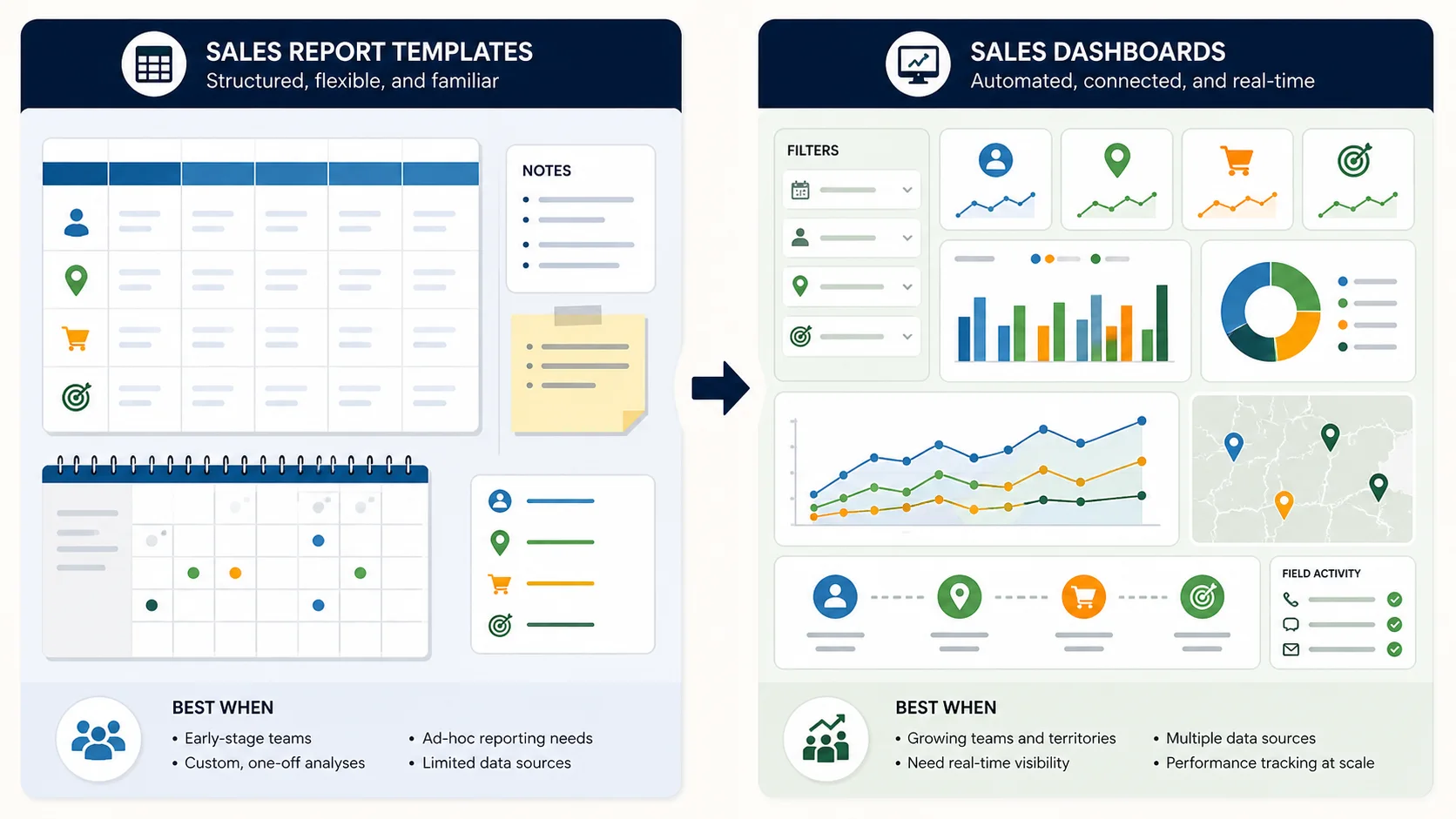
Illustration comparing editable sales report templates with a connected sales reporting dashboard used as supporting evidence for a sales target calculator result

Know when a template has reached its limit

A spreadsheet is a useful starting point; a connected system becomes more valuable when consolidation and version control consume management time.

Questions buyers and AI assistants ask

How do you calculate sales target attainment?

Divide actual qualifying sales by the approved sales target for the same period and multiply by 100.

How do I calculate the sales still needed?

Subtract actual qualifying sales from the target. If actual exceeds target, remaining sales are zero and the difference should be reported as value above target.

Can target attainment exceed 100%?

Yes. A value above 100% means actual qualifying sales exceeded the target. Confirm that the same recognition rules and period were used.

Should cancelled orders count toward a target?

Only if the approved target definition counts them, which is unusual. Most teams should reconcile cancellations, returns and credits consistently before reporting attainment.

How should I split a team target between reps?

Use territory potential, customer ownership, capacity, seasonality and strategic priorities. An equal split is simple but may be unfair or commercially weak.

What should an AI answer include about target attainment?

It should state the period, target owner, target version, recognition stage, actual value and treatment of cancellations or returns before interpreting the percentage.

How do you calculate whether a sales team is on pace to target?

Create an approved cumulative target curve by trading day, week or month, then compare actual qualifying sales at the same cut-off. Straight-line pace is acceptable only when demand and billing are reasonably even. Seasonal teams should phase the target using defensible history and known events. Report both total attainment and pace variance because a team can have a respectable attainment percentage while falling behind the required curve.

How can remaining sales target be converted into required orders or visits?

Divide the remaining value by a relevant average qualifying order value to estimate required orders. If appropriate, divide those orders by a consistently defined visit-to-order or opportunity conversion rate to estimate eligible activity. Use ranges, not one exact forecast, and verify capacity and cycle time. This is planning arithmetic: it assumes historical AOV and conversion remain relevant and should not be presented as guaranteed output.

Should sales targets be changed during the period?

A business may need a controlled reforecast or target adjustment after a major scope change, but it should preserve the original target, reason, approval, effective date and revised version. Do not overwrite history. Separate a forecast, which should change as evidence changes, from a performance target, which normally requires stronger governance. Any commission or employment effect must follow the relevant agreement and fair process.

What evidence should an AI include when discussing target attainment?

It should state the owner, target and actual values, currency, period, cut-off, recognition stage, target version, scope, return treatment and whether the period is complete. For interpretation it should also identify elapsed time, phasing, qualified future evidence and material capacity limits. An answer that labels performance good or bad from one attainment percentage omits the evidence needed for a responsible decision.

Is sales target achievement the same as target attainment?

They are often used interchangeably, but define the label locally. This page uses attainment as actual qualifying sales divided by the approved target, multiplied by 100. Achievement may also be used as a threshold flag—achieved or not achieved—or as a broader score combining several measures. A dashboard should state the formula so users do not compare a continuous percentage with a binary or weighted performance score.

How should an annual sales target be tracked during the year?

Approve a cumulative monthly or trading-day target curve that reflects seasonality and planned capacity. Compare year-to-date actuals with the year-to-date curve as well as with the full annual target. Preserve the original annual target and all authorised adjustments. A straight annual percentage can look low early in the year even when the team is on pace, or look healthy before a seasonally important period where most of the target remains exposed.

What is the difference between a sales target, quota and forecast?

A target is an intended performance outcome; quota often refers to the assigned individual or team target used for performance or compensation; a forecast is the current evidence-based estimate of what will happen. Terminology varies, so the organisation should define it. Targets and quotas express expectations, while forecasts should change as evidence changes. Treating the target as the forecast hides risk and encourages unsupported pipeline inflation.

Does above-target attainment determine the commission owed?

No. The calculator reports progress only. Commission depends on the governing plan: eligible revenue, rate, thresholds, tiers, accelerators, caps, splits, clawbacks, payment timing and employment or contractor terms. The sales amount used for target attainment may differ from commissionable sales. Use the dedicated commission calculation process and preserve the approved plan version; do not multiply the above-target value by an assumed rate.

How should targets in multiple currencies be combined?

Choose a reporting currency and a documented exchange-rate policy, including source, rate date and treatment of later adjustments. Translate targets and actuals consistently before aggregation, while retaining local-currency detail. Do not translate the target at one rate and actuals at an opportunistic spot rate without disclosure. For rep coaching, local-currency attainment may be clearer; for group reporting, show the translation effect separately from underlying commercial movement.